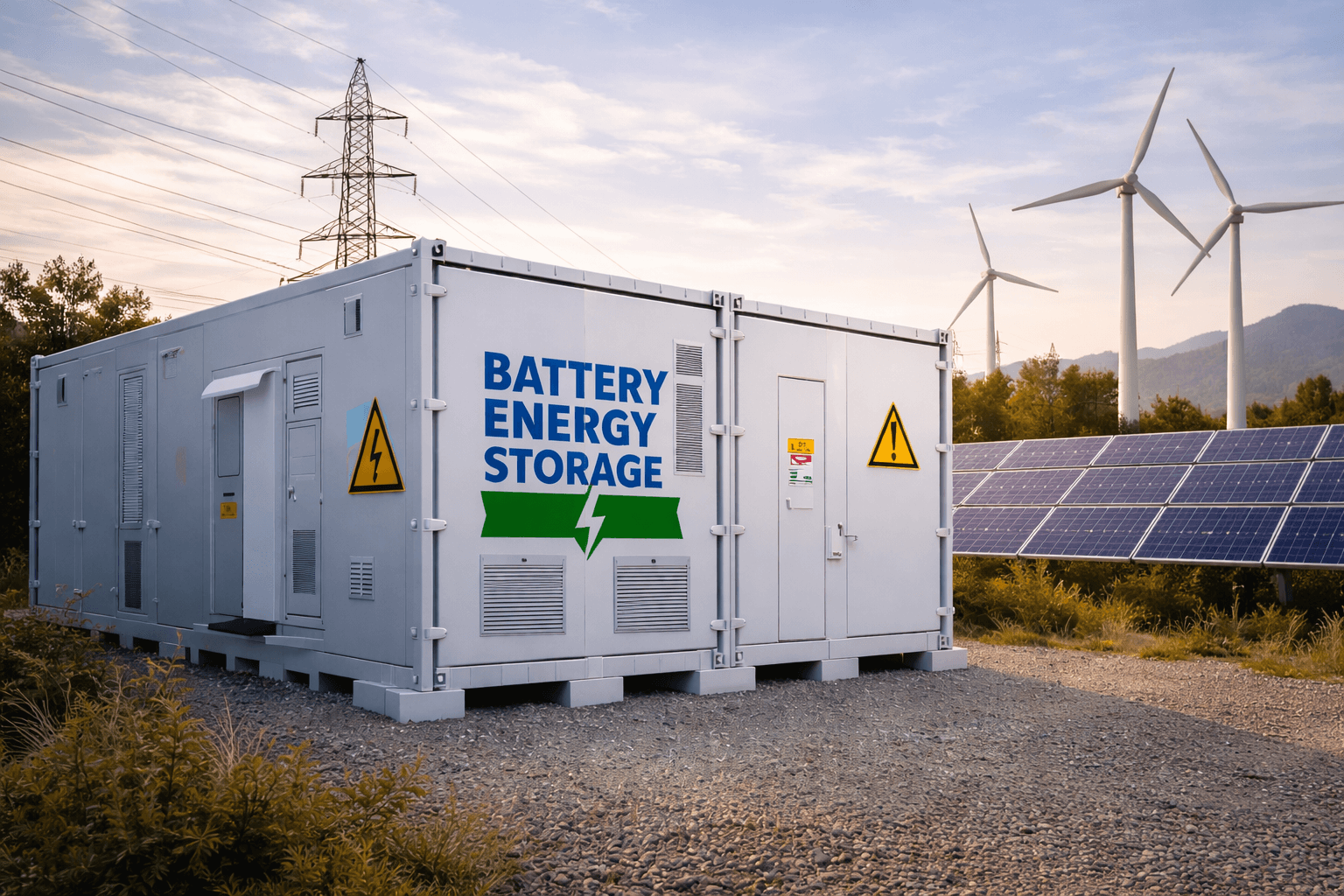
Battery Energy Storage Systems (BESS) are moving from pilot relevance to mainstream project evaluation in India’s power sector. Policy support has expanded, procurement activity has accelerated, and the market is beginning to reflect more demanding expectations on discharge duration, availability, safety, and lifecycle performance. Recent Ministry of Power disclosures indicate that India already has 798 MWh of operational BESS capacity above 1 MWh, with approximately 35.8 GWh under construction. The government is also supporting early deployment through two Viability Gap Funding (VGF) schemes covering around 43 GWh, while eligible co-located BESS projects continue to benefit from ISTS charge waiver support up to June 2028.
For businesses examining this space, the practical questions now relate to project structure, use-case fit, technical configuration, safety design, contractual allocation of risk, and long-term financial viability.
Recent official disclosures also show that the sector is scaling quickly in pipeline terms, not only in policy intent. With operational capacity already established and substantially larger volumes under construction and tendering, BESS in India is now part of the mainstream project evaluation landscape for utilities, renewable developers, industrial consumers, and infrastructure investors.
Why BESS is Suddenly Central to India’s Energy Narrative
India’s renewable capacity expansion has increased the need for flexible resources that can shift energy, support system reliability, and improve dispatch quality. BESS is therefore becoming more central to procurement, planning, and grid operations. The policy environment has also become more structured. Tariff-based competitive bidding guidelines for BESS procurement were notified in March 2022, storage-based resources were permitted in ancillary services, electricity supplied from BESS has been allowed to participate in the High-Price Day-Ahead Market, and the September 2025 amendment to the Electricity Rules widened the range of ownership and operating models.
In February 2025, CEA also issued an advisory on co-location of energy storage with solar projects, and draft safety and technical construction regulations were issued in 2025 to strengthen design and compliance expectations.
The Tender Boom: Growth Engine, or a Stress Test?
The fastest way to understand what is changing is to look at the structure of recent tenders.
Many state and central tenders have converged around configurations such as 2-hour systems and utilization assumptions like two cycles per day, because these parameters align with peak-shaving, renewable firming, and arbitrage use cases.
At the same time, tenders are experimenting. Industry observers note that 2025 saw innovations including different duration requirements, cycling expectations, grid-forming demands, and assorted “freebies” or scope allocations (land, auxiliary power, evacuation arrangements). This experimentation is positive, but it also creates confusion, because bankability depends on predictable allocation of responsibilities and risks.
Where businesses should be cautious is that tender design can unintentionally reward the wrong behaviour. When bidding becomes a race to the bottom, it can incentivise unrealistic degradation assumptions, thin warranties, and aggressive cost compression in safety-critical equipment.
In BESS, a low tariff by itself does not establish project strength. Long-term performance, safety, availability, augmentation planning, and return discipline matter just as much.
The Policy Tailwinds that are Reshaping Project Economics
Several policy signals matter because they directly change cashflows and risk.
1) Viability Gap Funding and Scale Targets
Government communications highlight VGF support for large-scale BESS, with defined outlays and MWh targets. These schemes are intended to close the viability gap and bring down the delivered cost of storage-based services. The Government is implementing two VGF schemes intended to support approximately 43 GWh of BESS and accelerate early-stage deployment.

From a business perspective, VGF changes two things:
- It can compress required tariffs to a level discoms can accept.
- It can create a competitive rush, where bidders underprice assuming policy support, faster clearances, and perfect execution.
2) Inter-State Transmission System Charge Waivers (for eligible projects)
Inter-state transmission charge waiver support for eligible co-located BESS projects up to June 2028 can materially improve delivered project economics, but only where the project structure and commissioning conditions remain aligned with the applicable policy framework.
This helps viable projects become more competitive, but it also adds compliance pressure: missing eligibility dates or conditions can undermine the entire financial model.
3) National Policy Direction
The National Electricity Plan, 2023 has also projected a requirement of 208 GWh of BESS by 2030, which gives developers, lenders, and utilities a clearer sense of expected scale. These measures do not remove project risk, but they do change how viability is assessed, how bids are structured, and how financial models should be built.
Current Status of BESS Deployment in India
Recent Ministry of Power responses indicate that India’s BESS market has moved beyond the early demonstration stage. As of March 2026, operational BESS capacity above 1 MWh stood at 798 MWh. The government also indicated that 9,653.94 MW / 26,729.32 MWh was under construction and 19,797.65 MW / 61,013.40 MWh was at the tendering stage. This scale matters because market participation is now being shaped increasingly by implementation capability, technology selection, safety compliance, commercial structure, and lifecycle performance.
Why Aggressive Bidding Needs Careful Evaluation
If your business is considering bidding, partnering, financing, or supplying into BESS projects, you should treat ultra-low tariffs as a diagnostic prompt.
Here are the common failure modes behind “too good to be true” bids:
1) Degradation Optimism and Augmentation Denial
Battery performance declines with use, temperature, and calendar ageing. Two cycles per day in a 2-hour system is not a benign operating profile. If bidders assume slow degradation without a clear augmentation plan, the project can meet early-year performance but fail in later years, triggering penalties, disputes, and refinancing stress.
2) Warranty Ambiguity
A “10-year warranty” can be structured in ways that shift risk back to the owner: narrow operating envelopes, exclusions for ambient temperature, limited throughput, or complicated claim processes. The contract may look robust until year 6 – 8 when performance drops and the owner learns what is not covered.
3) Safety and Thermal Risk Underestimation
Safety engineering is expensive: cell selection, module design, BMS logic, fire detection, suppression, ventilation, separation distances, and emergency response protocols. When projects are priced too tightly, safety can be where corners are cut. Reports have noted the concerns about low-quality batteries and safety risks, especially in high-temperature regions.
4) Execution Capability Mismatch
A tender win does not equal delivery capability. India’s market is seeing new entrants. Some will build strong teams and succeed; others may rely on thin EPC structures and weak O&M, leading to delayed Commercial Operation Date (COD), performance under-delivery, and claims.
For investors and lenders, the BESS market is therefore entering a “credibility screening” phase. Business owners should expect more scrutiny on vendor bankability, warranty strength, grid integration readiness, and operational track record.
| Planning to evaluate a Battery Energy Storage System project in India? Before moving into vendor discussions, tariff assumptions, land identification, or capital deployment, it is important to assess use-case suitability, lifecycle economics, safety requirements, policy-linked eligibility, technical configuration, and execution feasibility. Hmsa Consultancy supports such mandates through structured feasibility studies, bankable project reports, commercial evaluation, and strategic advisory aligned to real investment and implementation decisions. Share your requirements with us here. |
Which Business Categories Face the Greatest Exposure Beyond BESS Developers?
BESS affects multiple business categories, often indirectly.
1) Renewable Generators and Hybrid Developers
Storage can convert intermittent generation into dispatchable supply and improve offtake quality. But it also introduces battery lifecycle risk, augmentation obligations, and more complex contracting. Government advisories on co-location of storage with solar reflect the directional push.
2) Discoms and Large Commercial and Industrial Consumers
Discom procurement of BESS is often framed as a grid stability and peak management tool. Some state-level initiatives indicate growing interest in deploying BESS at substations and across networks.
For large consumers, the opportunity is reliability and tariff optimisation. The risk is signing poorly-structured “storage service” contracts that shift technical underperformance to the consumer through availability clauses or pass-through charges.
3) EPCs, Integrators, and OEM Supply Chains
A tender surge can create a short-term volume boom, followed by a quality shakeout. Firms that invest in QA, safety, testing, and documented commissioning will emerge stronger. Firms that chase volume without robust engineering may face reputational and contractual damage.
4) Financiers, Private Equity, and Strategic Investors
BESS is attractive because it is modular and fast to deploy, but it is not a simple infrastructure annuity. The asset behaves more like a “degrading machine” than a static plant. Underwriting must reflect operating regime, augmentation, warranty enforceability, and counterparty risk.
What Businesses Should Do Now
The right response is not panic. It is disciplined preparation.
Step 1: Decide your Exposure Type
Are you a developer, EPC, supplier, consumer, or investor? Each role has a different “risk owner” position. Your contracts must reflect that reality.
Step 2: Build a Bankable Lifecycle Model
A credible model must include:
- Throughput assumptions aligned to tender requirements (e.g., two cycles per day where specified)
- Degradation curves and augmentation scheduling
- Warranty coverage mapping to operating envelopes
- Penalty regimes and availability commitments
- Clear paths for compliance with policy-linked benefits (e.g., ISTS waiver eligibility timelines)
Step 3: Stress-test the Contract, not just the Tariff
Many BESS failures originate from legal and performance definitions:
- What constitutes “available capacity”
- How capacity is measured (metering point definitions)
- What happens if grid conditions limit charging or dispatch
- Force majeure and change-in-law treatment
- Dispute mechanisms and claim timelines
Step 4: Treat Safety as a First-Order Design Variable
Do not accept “standard containerised solutions” without safety documentation:
- Compliance certificates
- Thermal runaway mitigation approach
- Fire detection and suppression system design
- Emergency response plan aligned to site conditions
- O&M training and spares provisioning
Step 5: Choose Bankable Counterparties and Vendors
In a market where aggressive bids are common, bankability becomes a competitive advantage. Prioritise:
- Track record in comparable operating climates
- Transparent warranty terms
- Credible O&M capability
- Clear augmentation readiness
- Demonstrated commissioning and grid-integration competence
What the BESS Market will likely look like by 2027 – 2028
This section is opinion, based on observable market signals and not a guarantee.
- The market will likely bifurcate into high-quality, lender-friendly platforms and a long tail of weak projects.
The concerns about unviable low bids suggest the market is already testing its limits. - Tender requirements will likely become more standardized and technically gated.
As performance issues surface, procurers will tighten eligibility norms, testing requirements, and warranty standards. - Safety and warranties will become the differentiators, not EPC price alone.
Incidents or underperformance tend to trigger an overcorrection, after which safety engineering and documented compliance become non-negotiable. - Consumers will increasingly buy “storage as a service,” but only from credible operators.
Regulatory openness to consumer participation expands models, but buyers will demand availability certainty and enforceable performance clauses.
How Hmsa can Help
BESS is a sector where strategy, contracts, engineering realities, and financing assumptions collide. Many failures happen because teams treat it as either a pure engineering procurement or a pure financial arbitrage play. It is neither. We can support clients across standalone BESS projects, renewable co-location structures, industrial and commercial storage use cases, bid-stage project reports, lender-facing review exercises, and vendor or technology evaluation assignments.
As management consultants supporting energy and infrastructure businesses, we typically help in five practical ways:
- Commercial and Risk Structuring
We translate tender clauses, performance definitions, and penalty regimes into a risk allocation framework that management and lenders can sign off. - Bankable DPR and Lifecycle Economics
We develop lender-grade business cases that explicitly model degradation, augmentation, warranty enforceability, and policy-linked incentives (VGF, transmission waivers), so decisions are made on lifecycle truth rather than headline tariffs. - Vendor and Technology Diligence
We support partner selection through structured technical and commercial evaluation, including warranty term benchmarking, safety documentation checks, and O&M readiness. - Bid Strategy and Tender Response Development
We help clients choose where to bid, how to price responsibly, which risks hedging contractually, and how to craft submissions that are compliant, defensible, and execution focused. - Implementation Governance
For awarded projects, we set up execution governance (milestones, acceptance tests, document control, claim management) to reduce COD slippage and post-COD performance disputes.
If your business is exposed to BESS, the most valuable step is not to chase the next tender headline. It is to build a position that survives scrutiny: technically safe, contractually protected, and financially credible over the full operating life of the asset.
Reference: The Economic Times