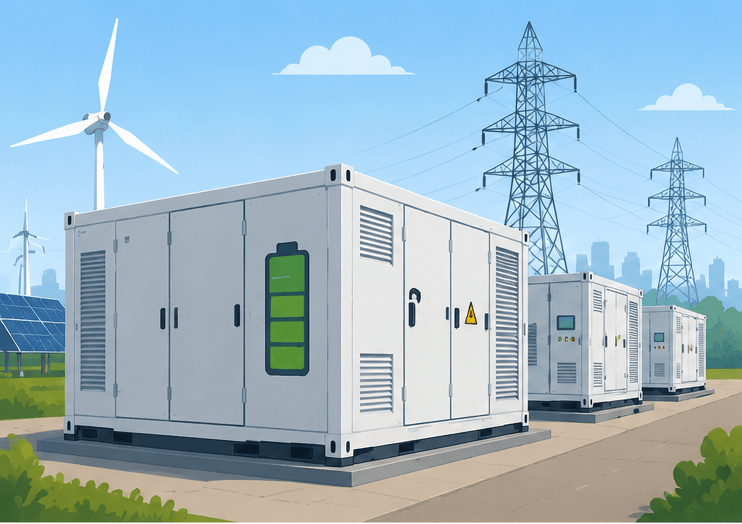
In the previous article of this series, we explained the fundamentals of Battery Energy Storage Systems, including how BESS works, its key components, major applications, and the broader market opportunity in India. This article moves from market understanding to project execution, focusing on why early assessment by experienced BESS Consultants can help businesses identify risks before committing capital.
Battery Energy Storage Systems, commonly known as BESS, are attracting serious interest in India’s energy sector. Growth in renewable energy capacity, peak demand management, grid flexibility requirements, and policy support are making battery storage relevant for developers, investors, utilities, and industrial consumers.
However, BESS project execution is not straightforward. A storage project may look attractive at the concept stage, but actual implementation can involve technical, commercial, regulatory, safety, and financial risks. Many of these risks are not visible in early vendor discussions or high-level cost estimates. They typically become clearer when the project moves into detailed configuration, grid connectivity, contract structuring, financing, procurement, construction, and operations.
For businesses evaluating BESS opportunities, professional assessment by experienced BESS Consultants can be valuable at an early stage. It helps identify project risks before major commitments are made and before assumptions relating to cost, performance, warranties, revenue model, and lifecycle obligations become difficult to revise.
BESS Projects are more Complex than Equipment Procurement
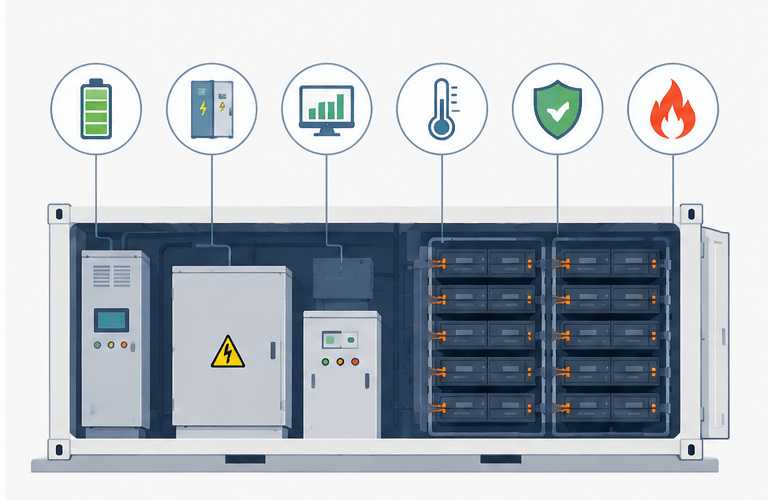
A BESS project is often understood as a battery installation. In practice, it is an integrated power infrastructure project. It includes battery containers, power conversion systems, battery management systems, energy management software, transformers, switchgear, metering, SCADA, cooling systems, fire safety systems, civil works, grid interface arrangements, and operating protocols.
Each of these elements affects project cost, performance, safety, reliability, warranties, and revenue generation. A system that appears cost-effective on the basis of upfront capital cost may not remain attractive once degradation, usable capacity, auxiliary consumption, operating profile, safety systems, warranty exclusions, and augmentation requirements are properly evaluated.
This is why BESS planning requires a structured feasibility and project assessment approach rather than a vendor-led procurement approach alone.
Key Challenges in BESS Project Execution
1. Defining the Right Use Case
A BESS project must be planned around its intended use. A battery storage system for renewable energy firming will not have the same design logic as one used for peak shaving, energy arbitrage, grid support, captive reliability, or backup power.
The use case influences storage duration, operating pattern, technology choice, vendor selection, grid interface requirements, and the commercial model. If the use case is not defined properly at the beginning, the project may be technically over-designed, commercially under-structured, or financially weak.
2. Technology and Configuration Risk
BESS projects are highly sensitive to technology configuration. Headline capacity expressed in MW and MWh is only a starting point. Project owners must review vendor-proposed parameters such as usable capacity, efficiency, thermal management, battery chemistry, PCS capacity, EMS capability, and operating conditions.
A low-cost configuration may not necessarily be suitable for the project’s required duty cycle or performance obligation. Similarly, a technically advanced configuration may not always be commercially justified. The project needs a balanced techno-commercial assessment.
3. Battery Degradation and Augmentation Risk
Battery capacity reduces over time. The rate of degradation depends on operating temperature, number of cycles, depth of discharge, charging pattern, chemistry, and system design.
If degradation is not properly modelled, the project may fail to deliver the expected capacity in later years. This can result in additional augmentation cost, lower revenue, warranty disputes, reduced availability, or contractual penalties.
In BESS projects, degradation is not a minor technical assumption. It directly affects project returns, lender comfort, tariff competitiveness, and long-term operating performance.
4. Revenue Model Uncertainty
BESS revenue can come from different sources depending on the project structure. These may include capacity payments, renewable energy firming, peak supply, ancillary services, energy arbitrage, captive reliability, or contracted availability.
In India, several BESS revenue models are still developing. This creates a risk where project economics are based on assumptions that may not be contractually secure or fully bankable.
Before proceeding, the revenue model must be tested carefully. The project owner needs clarity on how the BESS will earn, who will pay, what performance must be delivered, what risks are retained by the developer, and whether the cash flows are financeable.
5. Grid Connectivity and Interface Challenges
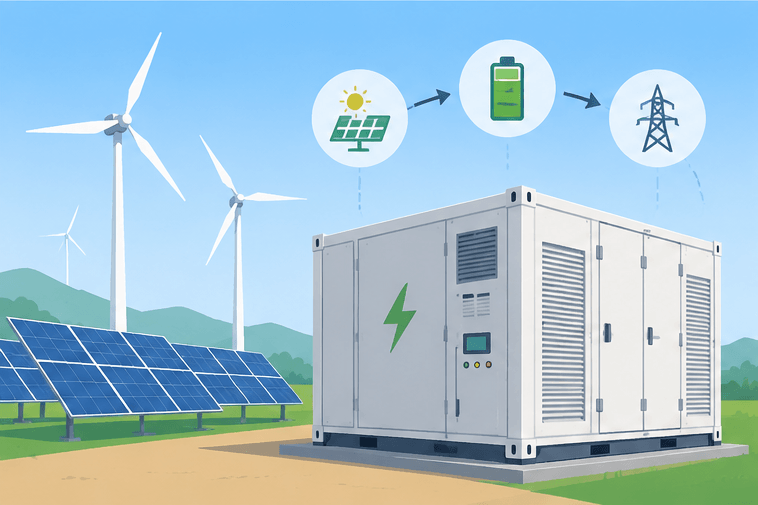
Grid connectivity can materially affect BESS project timelines and viability. Developers need to factor in substation capacity, evacuation infrastructure, metering, protection systems, grid code compliance, communication requirements, scheduling requirements, and approval timelines, based on inputs from technical agencies and utilities.
If grid interface requirements are not assessed early, the project may face delays, additional cost, or commissioning risk. For grid-scale and renewable-linked BESS projects, this can affect financing, offtake obligations, and project implementation timelines.
6. Safety and Compliance Requirements
BESS projects involve electrical, thermal, chemical, and fire-related risks. Safety requirements need to be considered early, rather than treated as an afterthought.
A serious BESS project must ensure that technical vendors and EPC contractors address container spacing, thermal management, fire detection, suppression systems, ventilation, emergency shutdown, site access, and electrical isolation.
Safety issues can affect regulatory approvals, lender confidence, insurance, community acceptance, and long-term operations. They must be assessed as part of feasibility, vendor evaluation, risk assessment, and project cost estimation from the beginning.
7. Vendor Warranty and Contractual Alignment
Vendor warranties are central to BESS project bankability. However, warranties may include important conditions relating to temperature, cycling, throughput, charging profile, state-of-charge window, maintenance protocol, approved usage, and operating data.
A project owner may assume that the battery warranty protects the project fully, but the actual warranty may not cover all contractual obligations under the offtake or tender agreement.
This mismatch can create significant risk. Vendor warranties, project obligations, insurance coverage, O&M arrangements, and financial assumptions must be reviewed together.
8. Financing and Bankability Concerns
BESS financing requires more detailed evaluation than a simple project cost and return statement. Lenders will typically look for clarity on revenue certainty, grid connectivity, technology reliability, degradation, augmentation, warranties, safety, O&M capability, insurance, and downside scenarios.
A BESS DPR or feasibility study must therefore address the project’s full lifecycle. It should not be limited to market commentary and broad financial assumptions. Weak feasibility work can result in unrealistic returns, insufficient contingency, poor risk allocation, and difficulty in achieving financial closure.
9. Operations and Lifecycle Management
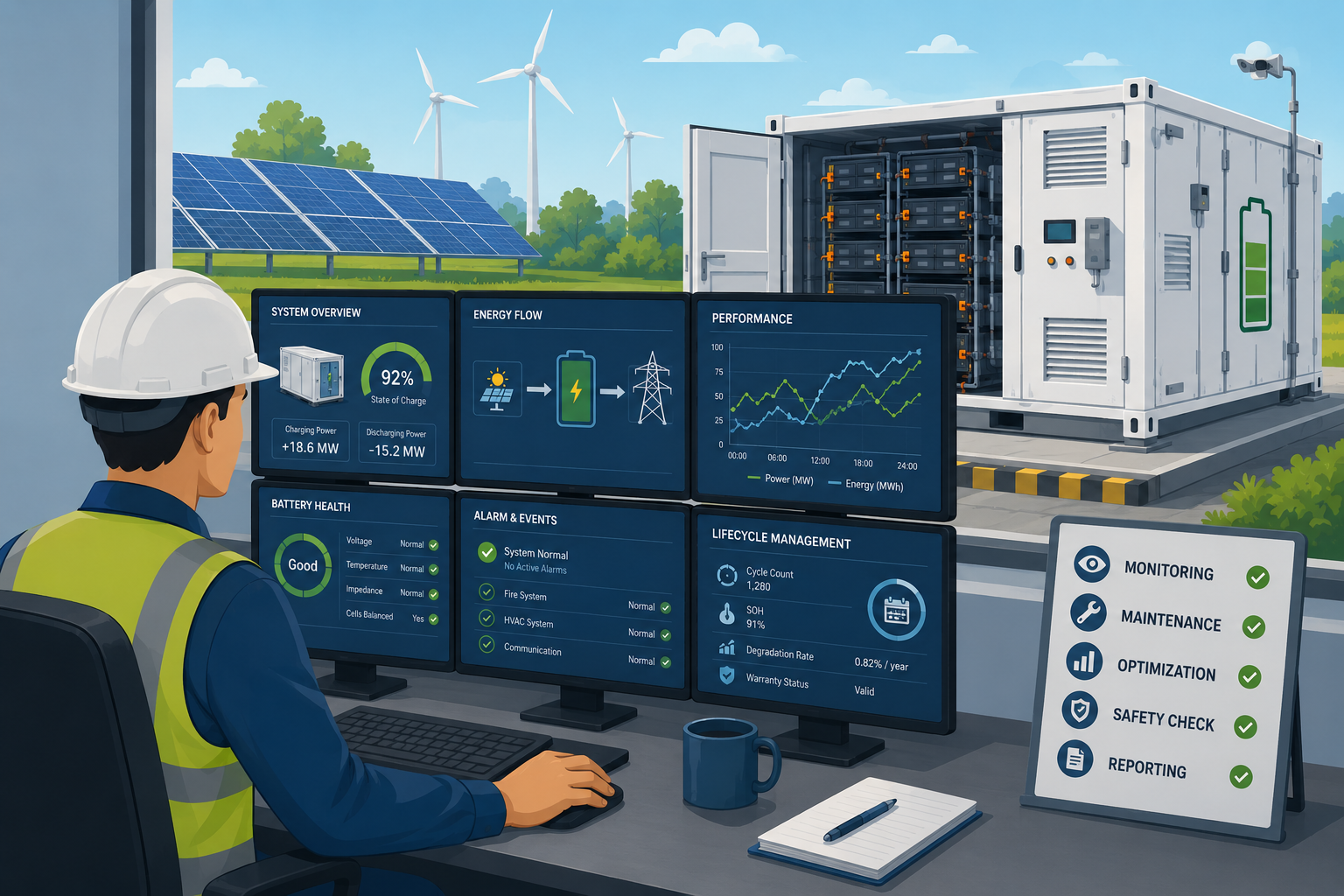
BESS projects require continuous monitoring and disciplined operations. Battery health, thermal conditions, PCS performance, EMS logic, fire safety systems, warranty compliance, data logging, maintenance, and augmentation planning must be actively managed.
A weak O&M framework can reduce system performance, accelerate degradation, create safety risks, and weaken warranty protection. Project owners must therefore evaluate lifecycle operating capability before committing to the project structure.
Why BESS Consultants Support is Important
Many BESS project risks become expensive to correct once land is identified, vendors are shortlisted, bids are submitted, financing discussions begin, or contractual commitments are made.
Professional advisory support helps project owners examine the opportunity before these decisions become difficult to reverse. It brings structure to the evaluation of project model, use case, technology assumptions, revenue logic, degradation, warranties, safety requirements, grid connectivity, financing, and implementation risks.
For BESS projects, BESS Consultants can help in:
• Assessing whether the proposed project model is commercially viable
• Defining the right use case and reviewing the proposed project configuration
• Reviewing CAPEX, OPEX, and lifecycle cost assumptions
• Evaluating degradation and augmentation implications
• Identifying vendor, warranty, and performance risks
• Assessing grid connectivity requirements, approval dependencies, cost implications, and execution risks
• Supporting lender-facing feasibility assessment or DPR preparation
• Mapping project risks before they become contractual liabilities
The objective is not to replace technical vendors or EPC contractors. The objective is to help the project owner make informed commercial and investment decisions before proceeding into procurement, financing, or execution.
| Planning to develop, bid for, finance, or invest in a BESS project in India? Before moving ahead with vendor selection, land commitment, tariff assumptions, financing discussions, or project structuring, it is advisable to assess vendor-proposed technical configuration, revenue model, degradation risk, safety requirements, grid connectivity, warranty exposure, and lifecycle financial viability. Hmsa Consultancy Services supports such evaluations through feasibility studies, detailed project reports, market assessment, bid advisory, financial evaluation, vendor assessment, and project structuring support aligned to real investment decisions. Share your requirements with us here. |
How Hmsa Consultancy Services Can Support
Hmsa Consultancy Services supports businesses, investors, developers, and project owners in evaluating BESS opportunities from a practical investment and execution perspective.
Our work can cover market assessment, project feasibility, DPR preparation, bid advisory, financial evaluation, vendor and technology assessment, risk mapping, and implementation planning. For BESS projects, this may include evaluation of the project model, use case, CAPEX and OPEX assumptions, revenue logic, degradation and augmentation approach, warranty considerations, grid connectivity dependencies, safety-related cost implications, and bankability risks.
This helps clients avoid under-structured projects, unrealistic assumptions, weak vendor alignment, incomplete risk assessment, and avoidable execution surprises.
Conclusion
BESS presents a meaningful opportunity in India’s evolving power sector, but project execution requires careful planning. The risks are not limited to battery prices or vendor selection. They extend to technology configuration, degradation, revenue structure, grid connectivity, safety, warranties, financing, O&M, and lifecycle management.
For businesses and investors, the quality of early-stage assessment can materially influence project viability. A well-structured feasibility study or DPR can help identify risks, test assumptions, support financing discussions, and guide implementation planning.
BESS projects should therefore be evaluated with the seriousness of long-term infrastructure assets. The earlier the project is assessed professionally, the better the chances of avoiding avoidable risks during financing, procurement, construction, and operations.