Why India’s REPM Tender Risks is Confusing Technology Documentation with Industrial Capability
India’s decision to support domestic manufacturing of sintered rare earth permanent magnets (REPM) is both necessary and overdue. The country imports its entire requirement of sintered NdFeB magnets, despite possessing rare-earth resources and some upstream capability in mining, separation and oxide refining. The Government’s 7,280 crore scheme seeks to correct this by establishing 6,000 metric tonnes per annum of integrated domestic capacity.
The strategic rationale is difficult to dispute. REPMs are critical inputs for electric vehicles, wind turbines, defence systems, aerospace applications and several advanced industrial products. A country aspiring to become a major manufacturing economy cannot remain indefinitely dependent on imports for such a strategically important component.
The more uncomfortable question is whether the tender issued to implement this ambition properly understands what it is trying to create.
A Concentrated Global Industry does not Transfer Capability Easily
Before examining the tender’s design, it is worth recognising how concentrated global REPM manufacturing actually is. China accounts for roughly 90 percent of global sintered NdFeB magnet production. Outside China, only a handful of companies, principally Shin-Etsu Chemical and TDK (Hitachi Metals, now Proterial) in Japan, along with a small number of European producers, operate integrated commercial-scale facilities. The universe of potential technology partners for an Indian programme is therefore extremely narrow.
China did not achieve this dominance through a single policy announcement or tender. Its rare-earth magnet industry was built over three decades through sustained state investment, directed academic-industrial collaboration, deliberate absorption of foreign know-how (including from Japanese pioneers), aggressive cost structures, and continuous process improvement across hundreds of producers. Japan’s own capability was developed by companies that invested decades in proprietary R&D, accumulated deep process knowledge, and protected it fiercely.
India’s scheme is attempting, through a competitive bidding process, to induce holders of this hard-won capability to transfer it to new entrants who, in most cases, have no prior experience in magnet manufacturing. The ambition is legitimate. The mechanism deserves scrutiny.
There is no Single Box called “REPM Technology”
The expression “REPM technology” gives an impression of something identifiable and transferable: find a technology provider, sign an agreement, import the machinery, train the operators and commence production.
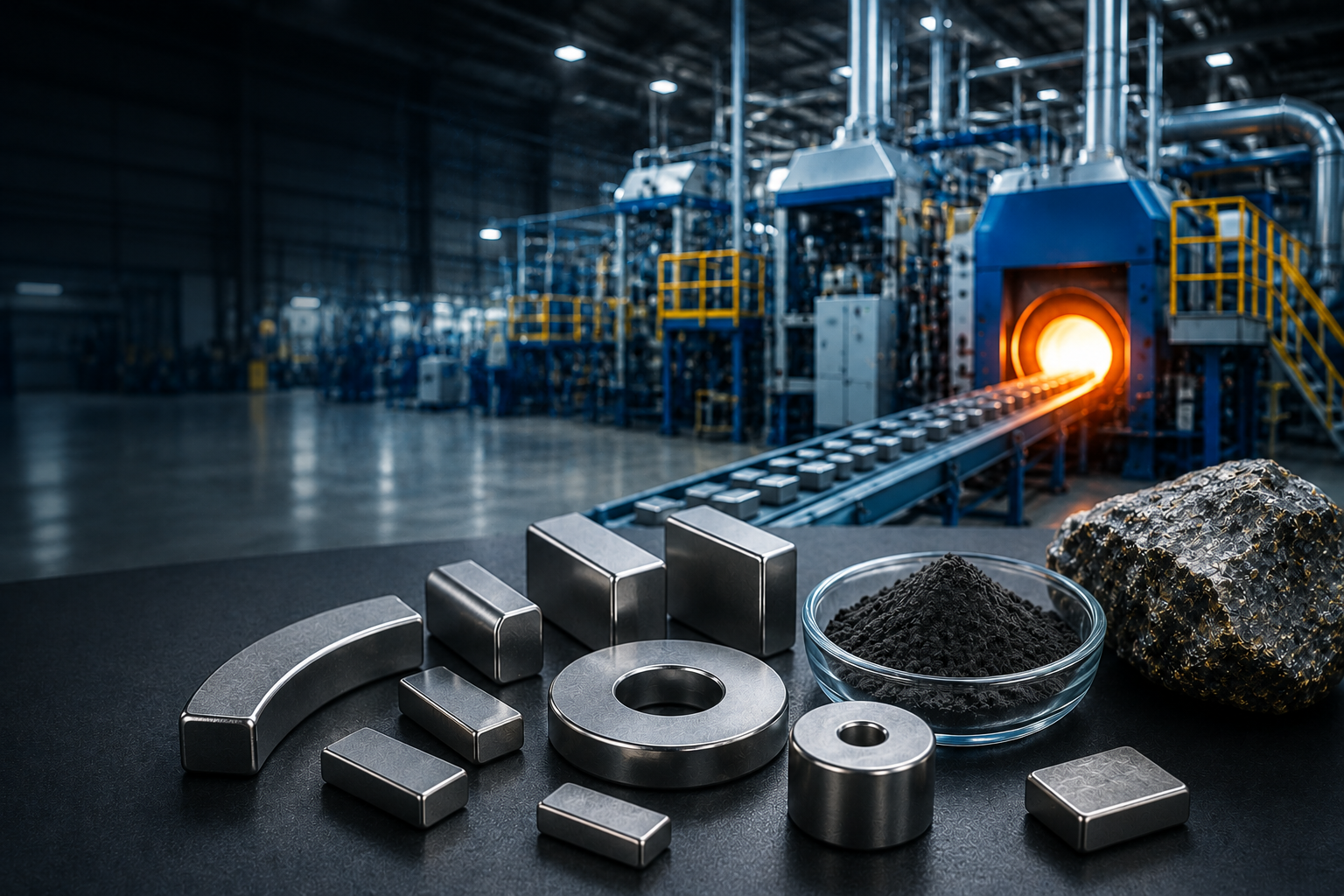
Integrated sintered NdFeB manufacturing begins with conversion of neodymium-praseodymium oxide into metal, followed by alloy preparation, strip casting, hydrogen decrepitation, jet milling, powder handling, magnetic-field orientation, pressing, sintering, heat treatment, machining, surface treatment, coating, magnetisation and extensive testing. Each stage affects what follows. The chemical purity achieved during metal conversion influences alloy quality. Powder size and oxygen content influence magnetic performance. Sintering parameters affect density, coercivity and remanence.
A manufacturer can possess every major item of equipment and still fail to produce magnets that customers will approve. The difference often lies in matters that do not appear in an equipment list: furnace profiles, atmospheric controls, powder-handling practices, allowable impurity levels, recipe variations, process tolerances, inspection methods and the experience required to diagnose why a batch has failed.
Industrial technology is not merely a collection of drawings, specifications and operating manuals. It includes codified knowledge, tacit knowledge and the organisational ability to apply both repeatedly under commercial conditions. A technology agreement may transfer the first. It does not automatically transfer the second or create the third.
The Tender Accommodates 3 Fundamentally Different States of Readiness
To its credit, the tender does not treat the proposed facility as a generic manufacturing plant. Its detailed project report format requires bidders to explain four broad capability areas: oxide-to-metal conversion, alloy preparation and powder production, magnet fabrication and sintering, and testing and characterisation.
The difficulty emerges in what the bidder may submit as evidence of readiness. A bidder with an executed technology-transfer arrangement may provide the agreement and evidence of commercial production by the partner. A bidder without such an arrangement may provide other evidence of technology access. Most significantly, where neither exists, the bidder may provide a “clear time-bound roadmap” for acquiring technology.
These are not merely different documents. They represent contracted access, claimed capability of varying depth, and aspiration respectively.
The Government may have had practical reasons for this flexibility. Requiring executed technology agreements at the bid stage would likely have reduced eligible bidders to one or two, possibly none, given the narrow universe of potential partners. A scheme covering 6,000 MTPA across multiple beneficiaries needs a minimum competitive field. That trade-off is understandable.
However, the tender does not publicly disclose how the distinction is weighted in technical evaluation. There is no published scoring system showing whether an executed and comprehensive technology arrangement is materially superior to a well-written acquisition roadmap. A country attempting to create a strategic industry should be more transparent about the difference between possessing technology and intending to obtain it.
A Roadmap is not a Technology
A time-bound technology-acquisition roadmap cannot establish that any credible technology owner is prepared to transfer the required capability on commercially acceptable terms.
Technology owners do not necessarily view India’s scheme with the same enthusiasm as prospective Indian beneficiaries. A foreign manufacturer may see a large emerging market. It may equally see a request to help create a subsidised future competitor. The potential provider must decide whether to share detailed process recipes, customer-specific grade formulations, production tolerances, yield-improvement knowledge and troubleshooting experience. It must decide on exclusivity, export rights, intellectual property protection and responsibility when the transferred process underperforms.
A conventional licence offers an attractive appearance of certainty. For relatively mature processes, it can work. REPM manufacturing presents a harder proposition: the initial transfer is only the beginning, followed by years of support during commissioning, trial production, yield stabilisation, grade development and customer qualification.
A joint venture, where the technology partner holds equity, may provide stronger alignment through shared economic interest in successful outcomes. But several potential partners may refuse a JV precisely because it exposes proprietary process knowledge to a partner who could replicate it independently over time. The Chinese industry’s own history includes instances of exactly this dynamic. In practice, the appropriate structure will vary by partner, and the tender should not implicitly favour one over another.
What matters is the depth and durability of the technology relationship, regardless of its legal form.
Two Critical Gaps the Tender does not Address
The first is demand-side reality. Indian EV manufacturers and wind turbine producers currently source magnets from established, predominantly Chinese, suppliers with proven quality records. A new Indian manufacturer will need to qualify with these customers, a process that typically takes 12 to 24 months per customer per grade. Even a technically successful plant will face a significant market-entry challenge. The scheme focuses almost entirely on creating supply-side capability without addressing whether the domestic demand ecosystem is prepared to absorb output from new, unproven producers during the critical early years of operation.
The second is raw material security. India’s current domestic production of separated rare-earth oxides, particularly NdPr oxide, is insufficient to feed 6,000 MTPA of magnet production. If oxide must be imported, predominantly from China, then the scheme replaces dependence on imported finished magnets with dependence on imported feedstock. The strategic objective of self-reliance is only partially achieved. The tender would benefit from requiring bidders to demonstrate a credible raw material sourcing strategy, including plans for domestic oxide supply development.
| Evaluating Entry into Rare Earth Magnet Manufacturing? Successful entry requires careful assessment of technology access, raw material security, customer qualification, operating capability and financial viability. Hmsa Consultancy Services supports businesses through feasibility studies, technology and partner assessment, detailed project reports, financial evaluation and implementation planning. Share your requirements with us here. |
The Government is being Transactional where it needs to be Strategic
The tender places responsibility for technology acquisition substantially on individual bidders. That is administratively convenient. It is also strategically passive.
India is not purchasing an available standard technology from a competitive pool of eager suppliers. It is trying to induce international technology holders to participate in the creation of a domestic industry in a field characterised by concentrated know-how, geopolitical sensitivity and Chinese dominance.
This calls for active industrial diplomacy, not merely a tender condition. Before final capacity allocation, the Government could have undertaken a structured engagement programme: identifying credible global technology holders, engaging them on intellectual property and investment concerns, facilitating confidential interactions with shortlisted Indian promoters, and supporting technical diligence on both sides.
More practically, a stage-gated process could work within existing procurement frameworks. Stage one would shortlist financially and industrially credible promoters based on financial capacity, industrial track record and project feasibility. Stage two would give shortlisted promoters a defined period, perhaps 12 to 18 months, to secure and demonstrate binding technology access. An independent technical panel (drawing from institutions such as DMRL or C-MET, supplemented by international experts) would assess whether each arrangement covers all critical process stages, whether the partner’s technology has operated commercially, and whether adequate personnel support and knowledge-transfer mechanisms are committed. Only bidders crossing this threshold would proceed to financial evaluation and capacity allocation.
That would delay the auction. It would also materially improve the probability that winners can actually manufacture what the scheme intends to support.
Technology Absorption Matters more than Technology Transfer
Even an excellent transfer arrangement does not create permanent Indian capability unless the recipient can absorb, retain and improve the technology. The proposed enterprises must eventually operate without continuous foreign supervision, diagnose process failures independently, improve yields, develop new grades, adapt to customer requirements, qualify alternative raw materials, and train successive generations of technical personnel.
The scheme recognises R&D expenditure and expert manpower. What it needs is an explicit post-award framework for measuring absorption at defined intervals. At year one, the relevant question is whether the plant can produce to specification under supervised conditions. By year three, the question becomes whether Indian technical personnel can independently diagnose and resolve process failures. By year five, the measure should be whether the enterprise has developed new grades, qualified domestic raw material sources, and reduced continuing external technical dependence to a discretionary rather than essential level.
Without such a framework, India risks replacing dependence on imported magnets with dependence on imported technical intervention, a different form of the same vulnerability.
A Necessary Scheme that needs a more Demanding Process
The REPM scheme correctly identifies a strategically important gap. It is right to insist on integrated manufacturing from oxide to magnet rather than subsidising superficial downstream activity. The tender’s authors clearly understand the technical complexity of the manufacturing chain.
But the process still reflects a familiar policy instinct: announce capacity, invite bidders, examine project reports, allocate incentives, monitor investment, count commissioned plants. That approach works where technology is mature and suppliers are abundant. REPM manufacturing satisfies neither condition.
The Government is not merely selecting investors. It is selecting future custodians of a strategic industrial capability. Their technology relationships, production competence, raw material security and capacity to internalise know-how will determine whether India develops an independent magnet industry or assembles subsidised plants around continuing foreign dependence.
The distinction will not be visible on inauguration day. The furnaces will be installed, the production lines will be photographed, and the sanctioned capacity will be announced. It will become visible later, when plants must achieve stable yields, produce demanding grades, satisfy customers independently, and source feedstock reliably.
By then, the tender will have concluded successfully. Whether the REPM industry has done so will be a different question.