Artificial intelligence has moved from the innovation lab into the day-to-day workflow of Indian companies. What is changing now is not just tool usage, but how performance itself is measured. Increasingly, AI fluency is being written into employees’ key responsibility areas (KRAs) and appraisals. For India Inc, “using AI responsibly and effectively” is becoming a performance requirement, not a side project.
This article explores why organizations are taking this route, how leading firms are embedding AI in KRAs and KPIs, and what a practical roadmap looks like for HR and business leaders.
From Optional Skill to Performance Requirement
For a few years, AI experimentation sat with innovation teams, data science groups and forward-looking managers. The majority of employees could safely ignore it and still meet their goals. That comfort zone has collapsed.
Client programmes in consulting, IT services, banking, healthcare, retail and manufacturing are steadily shifting to AI-enabled delivery models. Proposals now assume AI-assisted research, content creation, coding, analytics or support. If employees do not know how to use these tools, the organization risks slower turnaround, higher cost and weaker quality than competitors that do.
The natural consequence is that AI fluency is being treated as a foundational capability, like digital literacy or spreadsheet skills were a decade ago. Once something becomes foundational, it must show up in performance systems. That is exactly what is happening with AI.
Why AI is being Written into KRAs
There are three main reasons why firms are explicitly inserting AI into KRAs instead of relying on voluntary adoption.
First, voluntary adoption is uneven. A few enthusiastic employees experiment aggressively, while many others wait on the sidelines. When AI usage is explicitly included in KRAs, it sends a clear signal that every role is expected to explore AI-assisted ways of working.
Second, linking AI to performance accelerates upskilling. Training alone does not guarantee behavior change. When appraisals and bonuses are partly influenced by how well employees have integrated AI into their work, they are more likely to practice and apply what they learn.
Third, AI-linked KRAs increase accountability. Managers can no longer claim that AI is a strategic priority while appraising people only on traditional metrics. When AI outcomes sit within KRAs, leaders and teams are jointly responsible for demonstrating tangible impact, not just running pilots.
Also Read: Transitioning from Labour Laws to Labour Codes in India
How Companies are Embedding AI in Performance Metrics
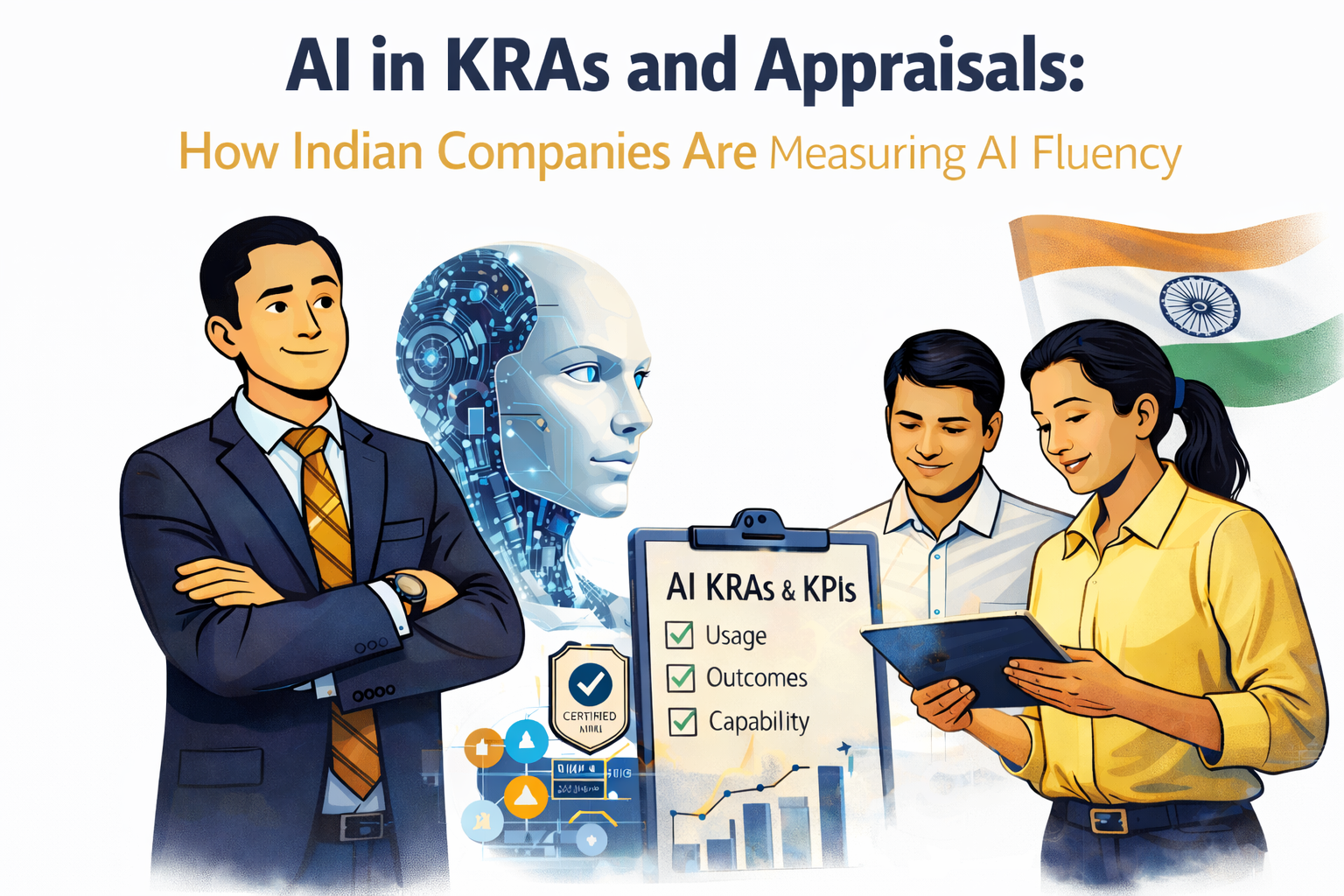
Organizations are approaching AI in KRAs and KPIs along three dimensions: usage, outcomes and capability.
At the usage level, employees are expected to “weave AI into everyday work”. For a consultant or analyst, this could mean using AI to prepare first drafts, synthesize research, create scenarios or generate visualizations. For a software engineer, it could be code completion, unit test generation and documentation. For a sales manager, AI can assist with account research, proposal drafting and pipeline analysis. These tasks are being explicitly mentioned in responsibility descriptions.
At the outcome level, firms are tying AI usage to traditional business metrics. Sales teams may be measured on conversion rates or revenue, but with an additional expectation that AI tools were appropriately used in prospecting and proposal work. Delivery teams may still be measured on quality and turnaround time, while being encouraged to show how AI reduced effort or improved accuracy.
Capability measures complete the picture. These include completion of AI training modules, internal certifications, or acquisition of an “AI skill badge” that signals proficiency. In some organizations, different levels of AI skill badges correspond to different expectations in KRAs and promotion criteria.
What Leading Organizations are doing
A number of large enterprises, across sectors, illustrate how this trend is playing out in practice.
A global professional services firm has introduced an “innovation” KPI for many roles, with a strong emphasis on responsible AI adoption and AI skilling. Senior partners and directors are not only sponsoring AI projects; their scorecards include the development and implementation of at least one AI use case within their area. This forces leadership to engage directly with AI tools, understand their limitations and champion adoption in client work.
A global technology and devices manufacturer has integrated AI into KRAs across multiple functions to build what it calls a future-ready workforce. In sales, AI-linked KRAs ensure that teams use approved tools for prospecting, opportunity qualification and proposal refinement, and that these practices translate into improved numbers. In product and technical teams, AI-related KPIs have become standard, reinforcing the expectation that generative AI is part of the normal toolkit. The company has also aligned its rewards ecosystem with this shift: bonuses and recognition are tied to strategic priorities such as AI, and employees who demonstrate meaningful AI-driven impact are explicitly acknowledged.
A large IT and business process services provider reports that a substantial majority of its technology workforce has already been trained on AI tools. Training is not the end point; KRAs have been recalibrated to ensure that this capability translates into everyday use. The shift is organization-wide, with expectations and support for employees at every level rather than treating AI as a niche competency.
Similar patterns are visible in several global capability centres and IT-services majors operating in India. The common thread is that AI is no longer limited to innovation centres or a few star teams. It is becoming embedded in mainstream performance dialogue.
The Pivotal Role of Leadership
When AI becomes part of performance management, the behavior of senior leaders is critical. If leaders insist that employees experiment with AI but do not use it themselves, the message loses credibility.
Forward-looking organizations are therefore placing explicit AI expectations in leadership KRAs as well. Business heads and functional leaders are undergoing formal AI training, committing to AI adoption metrics in their own scorecards and being held responsible for integrating AI-first practices into their functions.
This does two things. It ensures that AI adoption is not seen as a “tech team problem” or an HR initiative. And it turns leaders into role models who can talk concretely about how AI has changed their own work. When employees see their leaders using AI for decision support, communication and planning, it normalizes these behaviors.
Designing AI-linked KRAs and KPIs
For HR and business managers, the design challenge is to create AI-linked KRAs that are meaningful, measurable and responsible.
The starting point is clarity on what is actually being measured. An effective KRA will combine some indication of AI usage with a clear business outcome. For example, “use organization-approved AI tools to improve the quality and turnaround time of client proposals” is far more concrete than “experiment with AI during the year”.
Metrics should also focus on responsible usage rather than raw volume. It is easy to encourage excessive reliance on AI tools, which can lead to confidentiality breaches, inaccurate outputs or poor judgement. KRAs must therefore reference adherence to approved tools and policies. In some cases, quality reviews or peer checks can be part of the measurement system, especially for content or code that reaches clients.
Finally, AI expectations should be calibrated by role and seniority. Entry-level employees may be assessed more on learning and basic usage. Experienced staff may be expected to design or lead AI use cases, share best practices and mentor others.
Building the Enablers: Training, Tools and Rewards
Performance metrics on their own are not enough; employees need support to succeed.
Structured AI upskilling is the first enabler. Organizations are building learning journeys that combine introductory modules, role-specific deep dives and practical labs where employees solve real problems with AI. Internal skill badges or certifications help signal who has reached which level of proficiency and can be referenced in KRAs and promotion decisions.
Equally important is access to the right tools. Many companies are setting up secure AI platforms or approved toolkits that employees can use without violating data, security or IP guidelines. This reduces the temptation to use random external tools and allows risk and IT teams to set sensible boundaries.
Reward systems are also being aligned. In several organizations, bonus structures explicitly reference contributions to AI-driven innovation or productivity improvements. This does not mean everyone receives a separate “AI bonus”, but that successful AI usage can influence overall performance ratings and variable pay, just as revenue or project delivery has done traditionally.
Risks and Pitfalls to Avoid
While the momentum around AI in performance systems is positive, there are real risks if the change is mishandled.
One risk is overloading employees with AI expectations without providing adequate training, tools or time to experiment. This can breed cynicism and anxiety rather than enthusiasm. Another is focusing only on activity metrics, such as “number of prompts used”, which encourages superficial use rather than thoughtful integration into work.
There is also a cultural risk. If AI is framed as a way to eliminate roles, employees may see AI-linked KRAs as a threat and adopt a defensive posture. A better framing is AI as a co-pilot that enhances human capability, with performance systems rewarding those who can best use this co-pilot to deliver value.
Finally, ethical and compliance issues must not be ignored. Without clear guidelines, employees may inadvertently expose confidential information, rely on hallucinated outputs or amplify bias. KRAs should therefore emphasize responsible usage and adherence to organizational standards, not just experimentation.
A Roadmap for Organizations Wanting to Follow
For companies that are only beginning their AI journey, it can be tempting to copy the most advanced players. A more sustainable approach is to move in stages.
The first step is to articulate a clear AI ambition and policy: which business problems AI should address, what tools are permitted, and what boundaries apply. Once this is in place, organizations can pilot AI-linked KRAs in a few digitally mature functions such as sales, engineering or analytics, and learn from the experience.
As comfort increases, training programmes and approved tools can be rolled out more widely, supported by communities of practice where employees share success stories and pitfalls. HR can then progressively embed AI expectations into role descriptions, appraisal formats, promotion criteria and leadership development.
Throughout this journey, senior management must remain visibly engaged. When the CEO, CFO or CHRO can explain how AI has changed their own work and how it is reflected in their KPIs, the signal to the rest of the organization is powerful.
AI Fluency as a Core Performance Competency
The message from India Inc is clear: integrating AI into performance is no longer optional. As clients demand AI-enabled solutions and competitors use AI to improve speed and quality, organizations that treat AI as a peripheral experiment will fall behind.
Embedding AI fluency into KRAs and KPIs is proving to be one of the most effective ways to drive adoption, accelerate upskilling and create accountability. Done thoughtfully, it pushes employees and leaders alike to treat AI as a natural extension of their capabilities, not as a passing fad. The organizations that move early and design their performance systems well will be better placed to build the AI-native workforce that the next decade of business will demand.
How Hmsa Can Help
If you are an organization planning to embed AI fluency into KRAs and appraisals, Hmsa Consultancy can help you convert this intent into a measurable, role-wise and risk-controlled performance system. Our support typically spans:
- Designing role-based AI-linked KRAs and KPIs that combine usage, business outcomes, and capability levels
- Creating an AI competency and certification framework mapped to learning paths and promotion expectations
- Embedding responsible AI governance into performance management, including approved tools, data confidentiality, and quality controls
- Running pilots in select functions, quantifying impact, and scaling the approach with a practical rollout roadmap
The objective is to ensure AI performance metrics drive real productivity and quality improvement, without creating compliance risk or superficial “activity-based” adoption.
Reference: Economic Times