
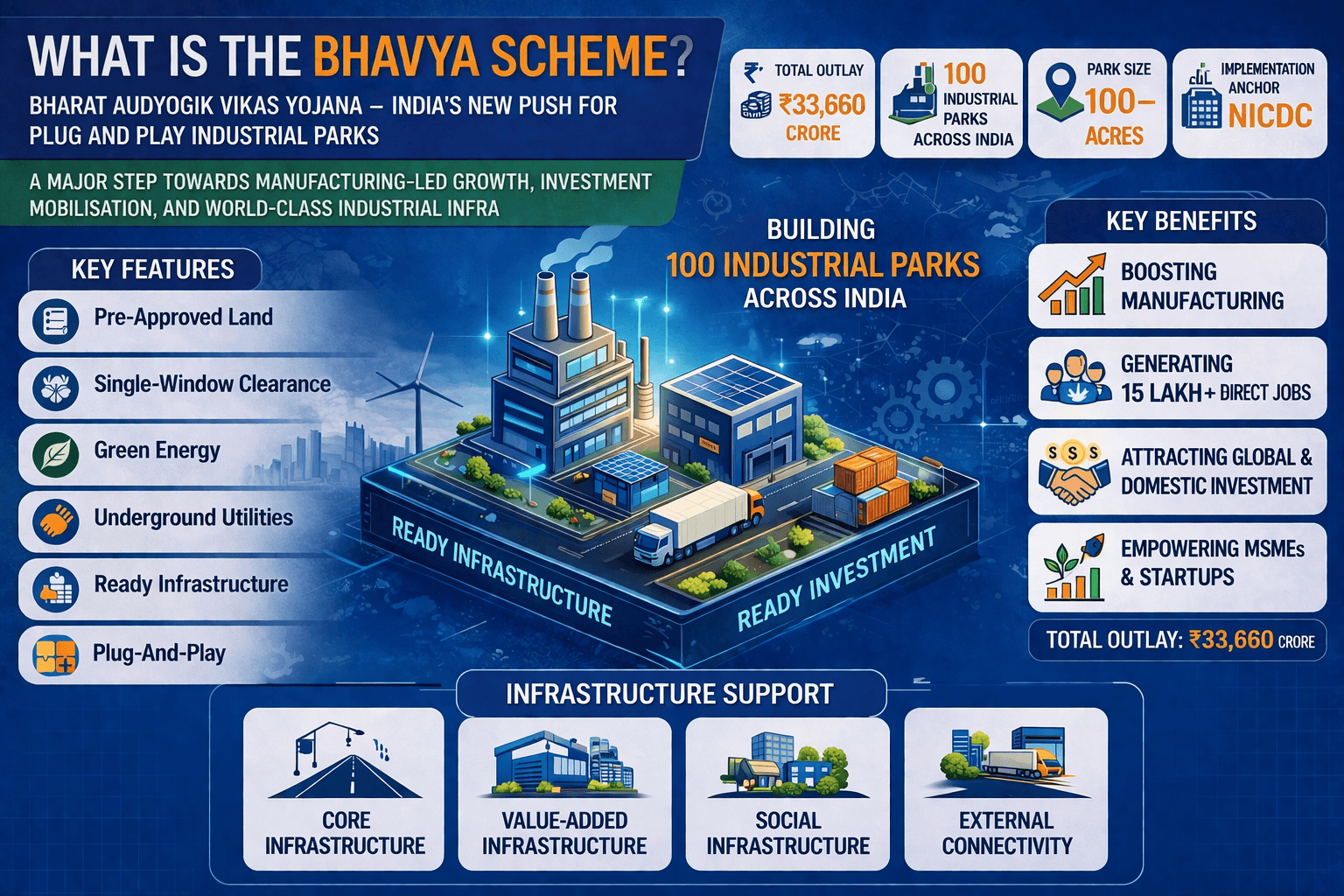
The Government of India has approved the Bharat Audyogik Vikas Yojana, or BHAVYA, as a major industrial infrastructure initiative with an outlay of ₹33,660 crore for development of 100 plug and play industrial parks across the country. The official announcement presents the scheme as part of India’s manufacturing-led growth agenda, with emphasis on investment mobilisation, employment generation, and development of world-class industrial infrastructure.
For businesses, the significance of such a scheme lies in the quality of industrial readiness it seeks to create. In industrial projects, land availability alone rarely determines viability. Utilities, logistics connectivity, internal infrastructure, worker-support facilities, approvals, and implementation capability usually influence both project timelines and commercial outcomes. The BHAVYA framework has been announced around these elements, with NICDC identified as the implementation anchor.
What the BHAVYA Scheme Covers
As per the official release, BHAVYA is designed to support industrial parks ranging from 100 acres to 1,000 acres. Financial support of up to ₹1 crore per acre has been indicated for eligible internal infrastructure, and support for external connectivity up to 25 percent of project cost has also been announced. The parks are intended to be developed with pre-approved land, ready infrastructure, and integrated services to reduce establishment timelines for industries.
The public scheme description refers to four broad infrastructure categories:
- Core infrastructure, including roads, underground utilities, drainage, and ICT systems
- Value-added infrastructure, including ready-built factory sheds, built-to-suit facilities, testing laboratories, and warehousing
- Social infrastructure, including worker housing and related support facilities
- External infrastructure to improve connectivity with the wider transport and logistics network
The selection framework has also been announced on a challenge mode basis. That makes project readiness and quality of preparation particularly important in practical terms.
Business Relevance of the Scheme
The scheme carries relevance for multiple business categories connected with industrial development.
Industrial Park Developers
For developers with land aggregation capability or industrial infrastructure experience, BHAVYA may create a route to participate in larger-format industrial park development with central support. The attractiveness of such an opportunity would depend on land position, connectivity, state support, infrastructure scope, and execution readiness.
Manufacturing Businesses
For manufacturing companies considering expansion, a BHAVYA-backed location may offer a more implementation-ready alternative to independent land acquisition and standalone infrastructure creation. This may be relevant for businesses seeking faster commissioning, better infrastructure support, or access to emerging industrial clusters.
State-Linked and Consortium Structures
State-linked entities, joint development vehicles, and consortium-led project structures may also find the scheme relevant where land availability, policy support, and industrial demand already exist in a particular region.
Ecosystem Participants
Warehousing operators, utility service providers, industrial support infrastructure players, and other ecosystem participants may find downstream opportunity where new industrial parks begin to attract occupiers and related investment.
These business implications go beyond the broad policy headline and arise from the scheme’s announced industrial park model and implementation structure.
Project Evaluation Considerations for Businesses
Businesses planning to enter this space would ordinarily need to evaluate the opportunity on multiple dimensions before committing meaningful time or capital.
Location Suitability
Industrial park economics are shaped by more than land size. The project location needs to be assessed on freight connectivity, proximity to demand centres, access to labour, utility availability, ecosystem compatibility, and future expansion potential.
Infrastructure Scope
Internal roads, utilities, common services, warehousing, testing infrastructure, worker facilities, and offsite connectivity all affect the attractiveness and usability of an industrial park. Weak infrastructure planning can affect both monetisation and implementation.
Commercial Viability
Public support can strengthen the project case, but it does not by itself ensure occupancy, pricing strength, development pace, or return on investment. The project still needs a commercially defensible development rationale.
Implementation Readiness
Land status, phasing logic, approvals pathway, utility tie-ins, stakeholder alignment, and execution capability become especially important under a challenge mode structure.
Project Documentation
Industrial park opportunities of this kind generally require structured technical, commercial, and financial preparation. In practice, businesses often need a feasibility study, project report, or similar document for internal evaluation, investor engagement, consortium discussions, or authority-facing submissions. The exact documentation format under BHAVYA may become clearer when detailed operational guidelines are issued, but disciplined project preparation remains necessary regardless. This point is an inference based on the announced scheme structure and standard industrial infrastructure development practice.
Why Preparation Quality will Matter
The announced challenge mode process increases the importance of well-developed proposals. In such frameworks, the difference between broad interest and serious participation often lies in the quality of site assessment, infrastructure planning, commercial logic, phasing, and presentation of implementation readiness. A project may appear attractive at announcement stage, but weak preparation can dilute competitiveness later.
Businesses entering this segment usually need clarity on:
- The industrial positioning of the park
- Likely occupier profile or sector focus
- Infrastructure and utilities configuration
- Phasing and development sequencing
- Indicative capital requirement
- Implementation dependencies
- Commercial viability under realistic assumptions
These are core project-development issues, not only scheme-awareness issues.
| Planning to participate in an industrial park, manufacturing infrastructure, or scheme-linked development opportunity under BHAVYA? Before moving into land commitment, promoter alignment, infrastructure planning, or capital deployment, it is advisable to assess location strength, development readiness, infrastructure scope, and commercial feasibility in a structured manner. Hmsa Consultancy Services supports such opportunities through feasibility studies, project reports, market assessment, project structuring, and advisory support aligned to real investment and execution decisions. Share your requirements with us here. |
How Hmsa Consultancy Services Can Support
Hmsa can support businesses evaluating BHAVYA-linked opportunities through a project-oriented advisory approach. Depending on the requirement, this may include:
- Opportunity assessment: Review of the scheme in the context of the client’s intended role, business objective, and project concept.
- Site and location evaluation: Assessment of land suitability, connectivity, industrial context, utility readiness, and broader locational attractiveness.
- Feasibility study and project report preparation: Development of a structured document covering project concept, indicative infrastructure requirements, land use logic, sector positioning, phasing, commercial rationale, and implementation considerations.
- Business case development: Assessment of project viability, development assumptions, and broader investment rationale for internal decision-making or stakeholder discussions.
- Proposal support: Support in shaping the project case for discussions with investors, consortium partners, authorities, or other stakeholders connected with the opportunity.
This is particularly relevant for businesses that want to move beyond preliminary interest and prepare a more structured project case around the scheme.
Conclusion
BHAVYA is a significant addition to India’s industrial infrastructure agenda. Its announced structure indicates a clear policy focus on plug and play industrial development with stronger land readiness, infrastructure support, and integrated industrial park planning. For businesses, the value of the opportunity will depend on project quality, location strength, infrastructure planning, and disciplined preparation. Companies approaching the scheme with a well-developed project concept and a commercially grounded implementation case are likely to be better positioned than those operating only at the level of broad scheme awareness.
FAQ
What is Bharat Audyogik Vikas Yojana?
Bharat Audyogik Vikas Yojana, or BHAVYA, is a Government of India scheme approved in March 2026 for development of 100 plug and play industrial parks, with an outlay of ₹33,660 crore.
Who may benefit from the BHAVYA scheme?
The scheme may be relevant for industrial park developers, manufacturing companies, state-linked development entities, and industrial ecosystem participants such as warehousing and infrastructure service providers.
What kind of infrastructure does the scheme support?
The official announcements refer to support for core infrastructure, value-added infrastructure, social infrastructure, and external connectivity.
Why is project preparation important under this scheme?
Because the scheme has been announced with challenge mode selection and industrial park development of significant scale, businesses would ordinarily need structured project preparation covering site, infrastructure, viability, and implementation readiness. This is an inference from the announced scheme framework and normal industrial infrastructure practice.
Reference: PIB