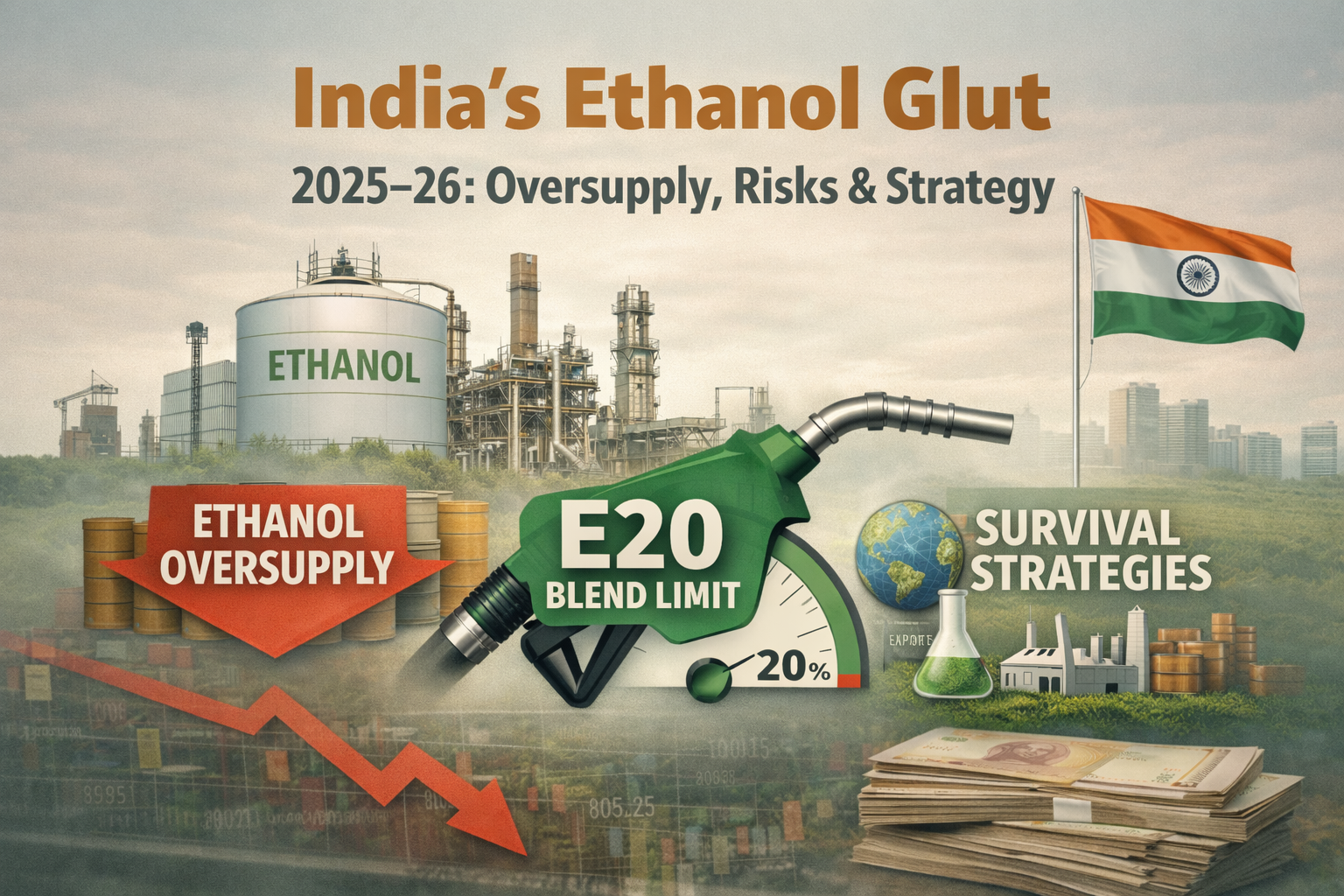
India’s ethanol market in ESY 2025 – 26 is showing a clear procurement-side oversupply signal. In Cycle 1, OMC demand was around 1,050 crore litres, while offers reportedly reached around 1,776 crore litres, implying oversubscription of roughly 1.69x. At the same time, the Government has stated that no decision has yet been taken to move beyond 20% ethanol blending, which means producers should not assume that a higher national blend pool will absorb excess capacity quickly. For plant owners, the issue is no longer only capacity creation; it is allocation, utilization, and survival strategy.
Executive Summary
- The ESY 2025 – 26 Cycle 1 tender requirement was about 1,050 crore litres; reported offers were about 1,776 crore litres, implying supply interest at ~1.7x of the tendered requirement and a clear oversupply signal for this tender cycle.
- India’s ethanol supply growth over the last decade has been steep: supplies to OMCs rose from 38 crore litres in ESY 2013 – 14 to 707 crore litres in ESY 2023 – 24.
- The blend wall remains real in the current policy framework: as of 20 March 2025, the Government had stated that no decision had yet been taken to increase ethanol blending beyond 20%, which limits the assumption that excess capacity will be absorbed quickly through higher mainstream blending.
- Blending momentum has remained strong, rising to 17.98% up to 28 February 2025 and 19.05% as of 31 July 2025, with July 2025 itself reaching 19.93%; this suggests India has effectively reached the E20 threshold, but not yet opened a clear higher-blend demand pool.
- A “shakeout” dynamic is plausible: capacity that is high cost, operationally weak, or feedstock constrained tends to exit or consolidate first when offtake tightens.
- Plant owners should act on four parallel tracks:
- cost and reliability leadership to win OMC allocations
- downstream diversification and offtake beyond EBP
- export readiness where permissible and competitive, and
- inorganic options including sale, consolidation, or relocation strategies.
- Lenders have a direct stake: with large debt-funded capex in the system, proactive operational improvement and strategy resets can be value-preserving versus passive restructuring later.
What the ESY 2025 – 26 Tender Data Says
The tender documentation itself is explicit on demand. A BPCL-issued corrigendum for Cycle 1 references “supply of around 1050 crore litres of denatured anhydrous ethanol” for ESY 2025 – 26 at OMC locations.
Market reporting on tender response indicates that offers received were materially higher than requirement. BioEnergy Times reported offers totaling over 1,776 crore litres against the ~1,050 crore litre requirement. ChiniMandi similarly reported allocation of ~1,048 crore litres against offers of ~1,776 crore litres, again underscoring oversubscription.
From a market-structure standpoint, this is not a marginal imbalance. If the tender requirement is 1,050 crore litres and offers are ~1,776 crore litres, the surplus “offer interest” is ~726 crore litres and the oversubscription ratio is ~1.69x. Even allowing for bid ineligibility, documentation issues, or pricing constraints, the gap is large enough to create competitive pressure on allocation, pricing expectations, and plant utilization.
Can This Be Called A “Glut”? A Practical Test, Not Just a Headline
A “glut” is commonly defined as flooding a market such that supply exceeds demand, and as an excessive quantity or oversupply.
To apply the term responsibly, it helps to test three conditions:
- Visible excess supply relative to near-term demand: The ESY 2025 – 26 Cycle 1 tender shows demand (1,050 crore litres) and reported offers (~1,776 crore litres) that exceed it substantially. This satisfies the “supply exceeds demand” condition at least for this procurement round.
- Capacity and system readiness to supply above demand: Government reporting notes “enhancement of ethanol distillation capacity to 1713 crore litre per annum” as an enabler. That is a national capacity number, not guaranteed deliverable supply, but it supports the view that the system has built substantial capability.
- Downward pressure mechanisms (allocation cuts, tougher procurement, or utilization stress): A further signal of tightening allocation is the feedstock mix itself. A Lok Sabha answer dated 3 December 2025 stated that, out of the 1,050 crore litre allocation for ESY 2025 – 26, 289 crore litres had been allocated to sugarcane-based feedstock. This does not by itself prove economy-wide surplus, but it does show that allocation pressure is now a live commercial issue across segments.
Based on these observable signals, the term “glut” is directionally defensible for describing the procurement-side imbalance in ESY 2025 – 26 Cycle 1. What cannot be claimed (without broader, verified data) is that every litre of installed capacity is commercially “surplus” across all grades, geographies, and compliance constraints. In other words, the market can be glutted at the aggregate level while still being tight in specific states, quarters, or feedstock categories.
How Did We Get Here? Policy Success Creates its own Constraints
The EBP Programme has delivered scale. Government data shows ethanol supply to OMCs rising from 38 crore litres in ESY 2013 – 14 to 707 crore litres with average blending of 14.60% in ESY 2023 – 24. Government also advanced the 20% blending target from 2030 to ESY 2025 – 26, reinforcing long-term demand visibility and investment confidence.
Official government data stated that blending reached 17.98% in ESY 2024 – 25 up to 28 February 2025, then 19.05% as of 31 July 2025, with July 2025 itself at 19.93%. In August 2025, the Petroleum Minister also stated that the 20% blending target had already been achieved in the current Ethanol Supply Year.
The same government note also lists “price stability and remunerative prices” and a structured procurement mechanism as part of the approach, which naturally reduced market risk for producers during the build-up phase.
When a sector scales under an assured buyer model, two things commonly happen:
- Entrepreneurs optimize for capacity creation and financing closure, not for differentiated go-to-market.
- Efficiency gaps remain hidden because the market clears at administered price and allocations.
Once demand growth hits a ceiling (or slows), the same architecture creates overhang: capacity remains, but allocation becomes the choke point.
The Blend Wall: Why “Can We Go Beyond E20?” is the Decisive Question
The EBP Programme is operationally framed around petrol blended with ethanol up to 20%. Moving beyond this is not only a policy decision. It requires coordinated readiness across vehicle compatibility, fuel standards, retail infrastructure, and consumer acceptance.
India has signaled enabling actions such as availability of E-100 and E-20 fuel and launch of flex-fuel vehicles. These are important, but they are not the same as converting the mainstream petrol pool to E25, E30, or higher blends at scale. Until a higher blend becomes the default national pool (or a meaningful parallel pool), the demand ceiling remains structurally close.
Recent government communication also indicates the programme continues to be actively managed, including feedstock-related measures and ongoing blending progress. The strategic takeaway for producers is simple: you should not base survival planning on an assumption that the blend wall will move quickly, unless and until there is a clear, time-bound policy and standards roadmap for higher blends.
In a Lok Sabha reply dated 20 March 2025, the Government stated that no decision had been taken to increase ethanol blending beyond 20%. That makes it risky for producers to base their survival planning on assumptions of E25 or E30 arriving quickly at scale.
“Installed Capacity” Versus “Marketed Volume”: Why Oversupply hurts even if Plants Run Well
In a rationed offtake environment, the pain is not evenly distributed. The sector typically splits into:
- Low-cost, high-reliability plants that OMCs prefer for consistent supply and compliance.
- Mid-tier plants that can survive, but only if they win allocation and keep costs tight.
- Higher-cost or operationally unstable plants that face underutilization, covenant stress, and eventual exit.
The “shakeout” dynamic is not a moral judgment. It is a predictable market response when supply capacity outpaces assured demand. The difference this time is that many plants were financed with an implicit assumption of stable offtake, which becomes fragile when allocations tighten.
A parliamentary response also notes that “more than 42,000 crore rupees have been sanctioned as loan by the banks/financial institutions for setting up of new sugarcane/grain-based distilleries/expansion of existing capacity” up to 31.10.2025. That single line explains why lenders must now care not only about plant operations, but also about strategy and market access.
Also Read: Bamboo Biomass-Based 2G Ethanol in India: Unlocking the Future of Biofuels
What Should Ethanol Plant Owners do Now? Four Strategic Plays
Play 1: Win The EBP Share by Becoming a Cost and Reliability Leader
EBP offtake is unlikely to disappear. The question is what share each producer captures when tender cycles are oversubscribed. A practical agenda for producers is to shift from “capacity as strategy” to “cost and reliability as strategy,” including:

- Feedstock strategy that is robust across seasons and policy-driven feedstock allocations.
- Plant yield, energy efficiency, water efficiency, and uptime discipline.
- Compliance and documentation maturity so bids do not get rejected on technicalities.
- Logistics performance and delivery adherence, since OMC supply chains penalize variability.
If procurement evolves from broadly distributed allocations toward stricter competitiveness (including the possibility of more price-led selection or tighter performance-linked allocation), this play becomes existential. This is also where lenders can demand measurable improvement, because operational excellence is one of the few levers that improves both cash flow and survivability without requiring a policy change.
Play 2: Diversify Downstream So Your Ethanol Has Multiple “Sinks”
When the single-buyer model tightens, producers need additional offtake “sinks” for ethanol. This does not always mean setting up a brand-new downstream plant. In many cases, the better route is partnership, contract manufacturing, tolling arrangements, or acquisition of a downstream player that already has market access.

Common downstream directions (depending on grade, compliance, and commercial feasibility) include ethanol-based industrial solvents, specialty chemicals, sanitizer and pharma applications, beverage and extra neutral alcohol (where permitted and aligned), and emerging low-carbon fuel applications such as sustainable aviation fuel pathways where ethanol can be a feedstock in certain technology routes. The exact set is less important than the principle: producers should redesign their business model so that OMC offtake is one pillar, not the only pillar.
This is where a professional strategy exercise is needed, because the attractiveness is segment specific. The margin pool, working capital cycle, regulatory requirements, and customer concentration can be materially different from the OMC model.
Play 3: Evaluate Exports, But Treat It as a Compliance and Competitiveness Project
Exports can be a pressure valve in an oversupplied domestic market, but only when three conditions hold:
- Export is permitted for the product category and feedstock under prevailing trade policy.
- Domestic pricing allows export parity after inland logistics, port handling, and ocean freight.
- Buyers accept the grade and certifications offered.

Global trade data shows that denatured ethyl alcohol (HS 220720) is imported by multiple countries, indicating that international markets exist. However, India’s export policy can be restrictive by category. For example, policy updates have explicitly addressed the export of second-generation ethanol under conditions such as export authorization and feedstock certification, which highlights that export is not a simple “sell abroad” decision but a regulated channel.
In practice, exporters typically need a structured workplan: product classification, DGFT compliance mapping, buyer identification, contract terms, credit risk controls, and a logistics model that keeps total landed cost competitive.
Play 4: Inorganic Options: Sell, Consolidate, Or Relocate Capability
When a shakeout begins, inorganic options often create the cleanest outcomes.
Pathways include:

- Sale of the operating company or the plant to a stronger domestic player that can extract operational synergies.
- Structured consolidation where multiple small plants are rolled up under a stronger balance sheet and a centralized procurement and marketing engine.
- Relocation or sale of plant and machinery to markets where feedstock availability, policy support, or demand growth is stronger, if the economics and regulatory route are workable.
- Partial exit models where the promoter retains minority equity in a new geography with a local partner, while recovering a portion of capital through stake sale.
These are not “last resort” moves. In a glut market, the winners are often those who execute early while assets still have strategic value and before distress pricing dominates.
What this Means for Lenders: A Shift from Monitoring to Active Value Protection
With significant debt-funded investments in distilleries, lenders should assume that “same plan, slower offtake” is a risk scenario, not a base case.
A lender-aligned response typically has three workstreams:
- Operational performance improvement tied to cash flow resilience.
- Strategic reset to build multi-channel offtake beyond OMCs.
- Transaction support to evaluate consolidation, sale, or structured exits where the promoter and lender interests align.
The ESY 2025 – 26 tender oversubscription suggests that policy-led capacity creation may have run ahead of assured offtake, at least in the near term. If the government’s intent was to overbuild to guarantee achievement of E20 under all conditions, that objective has arguably been met, but it now creates second-order consequences for plant utilization, promoter returns, and lender risk. The next phase of policy credibility will depend on how transparently the system manages this transition, whether through clearer long-term blending pathways, predictable allocation principles, and enabling new demand channels.
How Hmsa Consultancy can Help
If your ethanol project is exposed to lower-than-expected offtake, weaker utilization, or uncertainty after E20, Hmsa Consultancy can support a structured market reassessment, utilization strategy, diversification evaluation, lender-facing feasibility review, and transaction options assessment. Our support typically spans:
- Building an entry or reset blueprint covering market demand scenarios, EBP offtake strategy, and non-OMC demand channels to reduce single buyer dependence
- Designing feedstock and location strategy including sourcing model, seasonality risk, logistics economics, and price volatility mitigation
- Developing lender ready feasibility and DPR packs with defensible assumptions, unit economics, sensitivities, and funding structuring support
- Enabling tender readiness and bid support including eligibility interpretation, documentation pack readiness, compliance checks, and risk clause reviews
- Driving operational performance improvement to achieve cost and reliability leadership through yield, utilities, uptime, and debottlenecking programs with KPI governance
- Structuring diversification and partnerships for downstream products, tolling or contract manufacturing, and strategic supply agreements
- Supporting export and cross border opportunities through compliance mapping, buyer identification, export parity economics, and contracting support
- Delivering transaction support for consolidation, buy sell decisions, valuation logic, diligence, and integration planning
The objective is to protect promoter and lender value by improving competitiveness, creating multiple offtake options, and ensuring the business can sustain performance even under tighter allocations and more competitive procurement.
The ESY 2025 – 26 tender oversubscription suggests that policy-led capacity creation may have run ahead of assured offtake, at least in the near term. If the government’s intent was to overbuild to guarantee achievement of E20 under all conditions, that objective has arguably been met, but it now creates second-order consequences for plant utilization, promoter returns, and lender risk. The next phase of policy credibility will depend on how transparently the system manages this transition, whether through clearer long-term blending pathways, predictable allocation principles, and enabling new demand channels.
For more information and support reach out to us