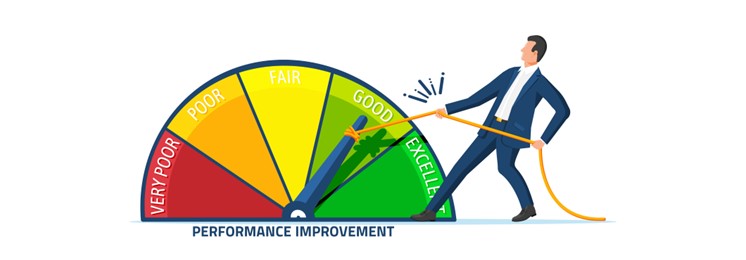
Why performance improvement matters?
Even with good products and capable teams, many organisations find that results fall short of potential. Revenue may be growing, but margins are tight. Capacity exists on paper, but bottlenecks slow delivery. Systems are in place, yet managers still rely on spreadsheets to run the business.
Performance improvement focuses on systematically strengthening:
- How work flows through processes and systems.
- How resources (people, assets, capital) are deployed and managed.
- How performance is measured, reviewed and acted upon.
- How roles, accountability and incentives support desired outcomes.
Done well, performance improvement can:
- Increase productivity and throughput without compromising quality.
- Reduce avoidable costs, leakages and rework.
- Shorten cycle times and improve customer service levels.
- Make performance transparent and easier to manage across levels.
Done poorly, it can result in cosmetic changes, consultant reports that do not stick, or initiatives that exhaust people without delivering sustained benefits. The difference lies in disciplined diagnosis, practical solution design and hands-on implementation support.
Typical triggers for a performance improvement programme
Organisations usually consider a structured performance improvement initiative when one or more of the following are true:
Margin pressure and rising costs
Revenue is stable or growing, but profitability is under pressure. Input costs, overheads or leakages appear to be rising faster than they should, and there is limited visibility on where the real issues lie.
Bottlenecks and low productivity
Capacity exists in plants, teams or systems, yet actual output is lower than expected. There are bottlenecks, idle time or uneven workloads across functions and locations.
Frequent process breakdowns and rework
Processes break down often. Work returns for corrections, complaints are recurring, and many problems are solved through firefighting rather than addressing root causes.
Growth beyond existing ways of working
The organisation has grown in volume, complexity, products or locations, but processes, systems and roles still reflect an earlier stage. Informal practices struggle to cope with current scale.
Under-utilised systems and tools
Significant investments have been made in ERP, CRM or other platforms, but adoption is patchy. Staff work around systems with manual tools, and management does not get reliable, timely information.
Preparation for transformation or transaction
Management is planning a strategic move – digital transformation, automation, expansion, merger or fund-raise – and wants to strengthen operational performance before making the next move.
Our role is to translate these triggers into a clear performance improvement roadmap that is data-driven, realistic and aligned with your strategic objectives.
Process and operations optimisation
We help review and optimise:
- End-to-end business processes such as order-to-cash, procure-to-pay, record-to-report, production, logistics and service delivery.
- Handoffs, checks and controls to reduce delays and errors.
- Layouts, routings and scheduling where relevant for operations.
This includes mapping current processes, identifying bottlenecks and waste, and designing future-state processes that are simpler, faster and better controlled.
Cost and margin improvement
We analyse:
- Direct and indirect cost drivers across functions.
- Productivity of manpower, equipment and working capital.
- Pricing, discounting and commercial practices that impact margins.
Based on this, we support:
- Identification and quantification of cost and efficiency opportunities.
- Design of cost optimisation measures that are sustainable, not one-time cuts.
- Linkage of cost initiatives to product, customer and channel profitability.
The objective is to improve profitability while protecting long-term capability and service.
Performance measurement, KPIs and dashboards
Improvement requires clear, trusted metrics.
We help:
- Define performance indicators for key processes and functions.
- Design scorecards and dashboards for different levels of management.
- Clarify ownership for monitoring and acting on metrics.
- Align performance reviews and governance forums with key KPIs.
This ensures that performance is visible and that issues are surfaced early, not after results are locked in.
Systems, data and process–system alignment
We review how systems and data support performance:
- Assess how existing systems (ERP, CRM, core platforms) are being used.
- Identify manual workarounds, duplicate data entry and inconsistent master data.
- Recommend changes to configuration, workflows and reporting to support better performance.
We connect systems work with process and role design, so technology becomes an enabler rather than a constraint.
SOPs, procedures and control frameworks
To sustain improvement, ways of working need to be standardised.
We work with your teams to:
- Develop or refine standard operating procedures (SOPs) for critical activities.
- Prepare policy and procedures manuals that are practical and clear.
- Design checklists and templates that support compliance with minimal friction.
- Integrate controls into processes so that compliance is built-in, not an afterthought.
This helps ensure that improvements are embedded and independent of individual memory.
Capability building and change support
Performance improvement initiatives often require new skills and behaviours.
We help:
- Identify capability gaps in process understanding, problem solving and use of systems.
- Design training and on-the-job coaching plans for managers and staff.
- Support line leaders in running performance huddles, reviews and problem-solving sessions.
We also work with HR to align performance expectations, appraisal criteria and incentives with the new ways of working.
Financial and value realisation lens
Where performance improvement is tied to financial outcomes, we bring a clear value lens:
- Link improvement initiatives to P&L, balance sheet and cash flow impacts.
- Define benefit tracking mechanisms and baselines.
- Prioritise initiatives based on expected value, feasibility and time to impact.
This connects operational work to financial results and helps management monitor whether the programme is delivering value.
How a typical performance improvement engagement progresses?
While each assignment is tailored to context, most performance improvement engagements follow a structured sequence:
Inception and scoping
Clarify objectives, scope (processes, functions, locations), constraints and success measures. Understand management priorities, pain points and timelines.
Diagnostic and opportunity identification
Review data, reports and existing diagnostics. Conduct process walks, interviews and workshops to understand how work is actually done. Map processes, capacity, bottlenecks and variation. Identify potential improvement areas and quick wins.
Problem definition and design principles
Define key performance issues and their root causes. Agree on design principles for solutions (for example, customer-centricity, control requirements, use of existing systems, resource constraints).
Solution design and prioritisation
Develop solution options for processes, structures, metrics and systems. Estimate effort and impact. Prioritise initiatives into waves or phases based on value and feasibility. Agree on owners and initial targets.
Implementation planning and mobilisation
Create a detailed implementation plan, including pilots, roll-out sequence, dependencies, communication, training and change management actions. Set up governance structures and review mechanisms.
Implementation support
Provide advisory and hands-on support during pilots and roll-out. Help refine solutions, resolve issues and adjust plans as needed. Support preparation of SOPs, templates and dashboards.
Review, benefits tracking and consolidation
Review progress against KPIs and value targets after defined intervals. Stabilise successful changes, address residual issues and hand over ownership to internal teams with clear processes for continuous improvement.
Representative performance improvement engagements
Team members at Hmsa have led and supported a range of performance improvement assignments, including:
- Performance and process improvement for a manufacturing client, combining shop-floor digital solutions, better planning and standardised work practices to improve throughput and reduce downtime.
- Business process transformation for a multi-location services organisation, simplifying back-office workflows, standardising processes and reducing rework and error rates.
- Capacity and performance improvement in a public sector or utility context, clarifying roles between central, regional and field units and aligning processes, KPIs and reporting.
- Cost and productivity improvement for a mid-sized enterprise under margin pressure, focusing on process efficiencies, overhead optimisation and tighter performance management.
- Performance framework and KPI design for a growth-stage company, linking strategic objectives to operational metrics and establishing a more disciplined review rhythm.
Many of these assignments have been linked to broader programmes involving business process re-engineering, systems upgrades, organisational restructuring and HR interventions.
Why organisations choose Hmsa for performance improvement?
Strategic and operational balance
We combine a strategy lens with an on-the-ground understanding of how work is actually done. This helps ensure that improvement initiatives are aligned to business priorities and grounded in operational reality.
Cross-sector experience
Our advisors have worked across manufacturing, services, financial services, infrastructure, development and public sector contexts. This diversity helps us bring tested ideas and anticipate practical issues.
Integration with BPR, SOPs, systems and structure
We connect performance improvement with process redesign, SOP and policy manual development, systems review and organisational aspects, rather than treating any one lever in isolation.
Transparent, data-based analysis
Our recommendations are supported by clear logic, data and, where available, benchmarks. This makes it easier to explain and defend decisions to boards, auditors, investors and staff.
Focus on people and sustainability
We recognise that performance improvement affects workloads, roles and habits. Our approach pays deliberate attention to communication, capability building and handover, so that improvements are sustained beyond the initial project.
How Hmsa can help?
If you are considering a structured effort to improve performance – whether driven by margin pressure, growth, operational challenges, digital initiatives or investor expectations – Hmsa Consultancy can support you through the full journey. We help diagnose performance issues, design practical solutions across processes, systems and roles, connect improvements to financial outcomes and support implementation so that benefits are realised and sustained. To explore what a performance improvement roadmap could look like for your organisation, you can reach out to us for a focused discussion with our senior team.