
Infrastructure and Smart Cities Opportunity Landscape
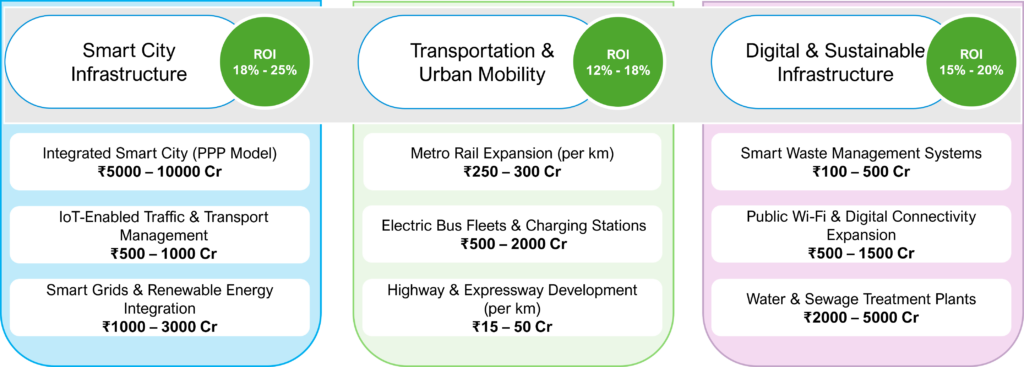
Market Overview and Growth Potential
Urbanisation in India is creating sustained demand for basic and advanced urban services, including transport, water supply, sanitation, power distribution, housing, and digital networks. As cities expand, the requirement is not only to build new assets, but also to modernise ageing construction through redevelopment and capacity enhancement, which creates continuous opportunities across EPC, O&M, technology integration, and urban services delivery.
Smart city development is also increasingly being treated as an integrated, multi-sector agenda rather than a standalone technology programme. City-level investments are now being designed around improved citizen service outcomes such as reduced travel time, enhanced safety, better utility reliability, and improved resource efficiency, which makes the opportunity relevant to both public works developers and technology providers.
India’s infrastructure and smart cities sector is experiencing rapid growth due to increased urbanization and government-backed initiatives. The Union Budget 2025-26 has emphasized:
- Urban development and smart city projects
- Public-private partnerships (PPP) in infrastructure
- Expansion of metro rail, highways, and digital connectivity
Key Market Indicators:
These indicators reflect both demand-side momentum and enabling conditions for project execution. Large-scale capex allocations generally translate into higher tendering activity and faster rollout of public works programmes, especially when supported by structured implementation mechanisms and defined pipelines at the central and state level.
For investors and promoters, the opportunity typically lies in selecting the right sub-segments such as metro and transit-oriented development, urban roads, water and wastewater, solid waste management, distributed renewable integration, EV charging infrastructure, and digital city platforms. The attractiveness varies by city based on growth trajectory, fiscal capacity, governance readiness, and existing asset gaps, which a feasibility study should assess at the micro-market level.
- India’s infrastructure sector projected to reach $1.4 trillion by 2030
- 100 smart cities under the Smart Cities Mission
- Capital expenditure allocation of ₹11.2 lakh crore in Budget 2025-26
- Faster approvals for real estate & infrastructure projects
Government Policies and Budgetary Support
Policy support influences feasibility primarily through improved project bankability and reduced execution risk. Viability gap funding, where applicable, can improve the revenue-risk profile of PPP projects by bridging the gap between project costs and the commercially viable level of user charges or annuity payments. This is particularly relevant for projects where public service outcomes are important, but full cost recovery through tariffs is not feasible.
Similarly, improvements in approvals and clearances can have a material impact on project timelines, which directly affects interest during construction, contractor mobilization efficiency, and the overall internal rate of return. Green infrastructure incentives can further strengthen the business case for projects that incorporate energy efficiency, renewable integration, electric mobility enablement, and climate-resilient design.
Budget 2025-26 Incentives:
- ₹1.2 lakh crore allocated for urban construction projects
- Viability gap funding for PPP-based smart city projects
- Faster land acquisition & single-window clearances
- Tax incentives & subsidies for green infrastructure
Key Challenges and Risks
- High capital costs and long gestation periods
- Land acquisition and regulatory hurdles
- Public adoption of smart infrastructure solutions
- Need for skilled labor in urban development and digital integration
Implementation Roadmap
Short-Term (0-2 Years)
- Identify high-growth urban centers for infrastructure investment
- Establish PPPs for metro, road, and smart utilities projects
- Implement pilot smart city projects with IoT & AI integration
Medium-Term (2-5 Years)
- Expand metro, expressway, and sustainable housing projects
- Scale up digital infrastructure with 5G, smart grids, and water management
- Promote private investment through urban redevelopment policies
Long-Term (5+ Years)
- Develop interconnected smart city networks across regions
- Implement fully autonomous public transportation systems
- Strengthen global positioning in sustainable urbanization & real estate
Conclusion
Infrastructure and smart city development in India presents high-growth, long-term investment opportunities with strong government backing. Businesses and investors can leverage emerging policies, public-private models, and sustainability initiatives to build scalable, future-ready construction solutions.
Reach out to us by filling the form to get a project report / feasibility study done to start a business in this sector.