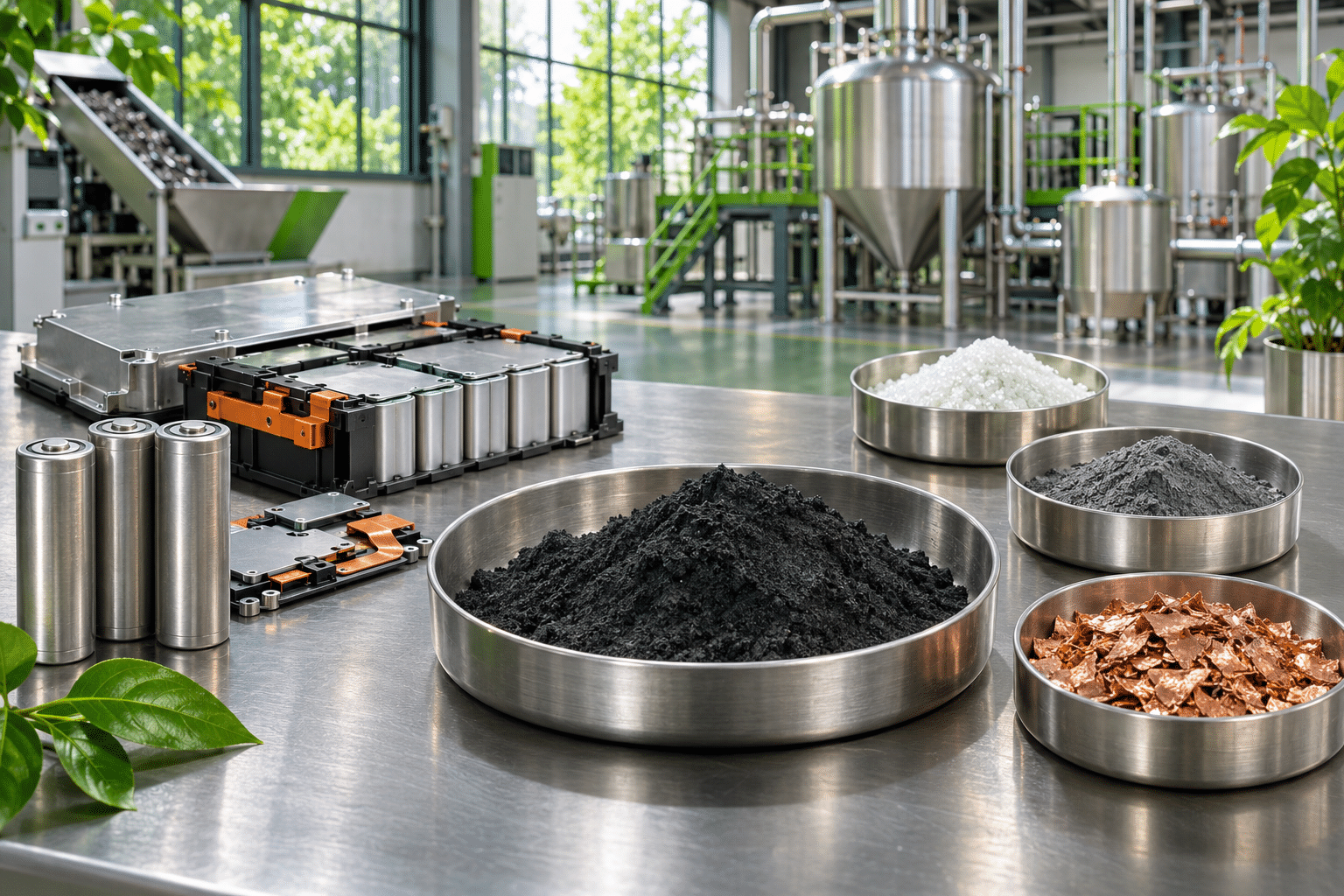
India’s decision to prohibit exports of specified lithium-ion battery black mass places greater emphasis on recovering critical minerals within the country. For the battery recycling industry, the measure could improve domestic feedstock availability and support investment in mineral recovery. Its commercial impact, however, will depend on how effectively businesses connect collection, processing and the sale of recovered materials.
The investment question extends beyond the availability of battery waste. A viable operation must secure suitable material at an acceptable cost, recover commercially useful products consistently and meet environmental requirements throughout the process.
What the Black Mass Export Ban Changes
According to the Ministry of Commerce and Industry, DGFT Notification No. 49/2026-27, dated 10 November 2026, changed the export policy for lithium-ion battery black mass under ITC(HS) code 85491400 from “Free” to “Prohibited”, with immediate effect and until further orders. Applicable transitional arrangements under the Foreign Trade Policy remain relevant.
The specified tariff entry covers unsorted waste and scrap of cells, batteries and accumulators not containing lead, cadmium or mercury. Businesses should therefore assess the notification against the classification and characteristics of their particular material.
The commercial implication is that businesses handling the affected material need to evaluate domestic processing arrangements, customer relationships and contractual commitments.
What is Battery Black Mass?
Black mass is a powdery material produced during the processing of used lithium-ion batteries and battery manufacturing scrap. It contains materials from battery electrodes that can undergo further treatment to recover useful minerals. Its composition varies with the batteries entering the recycling process.
Lithium-ion batteries encompass different chemistries, so a recycler cannot assume that every incoming batch offers the same recoverable material or value. The US Environmental Protection Agency describes multiple recycling routes, including processes that recover lithium, nickel, cobalt and manganese.
This distinction matters when assessing a recycling business. Collecting batteries, producing black mass and refining recovered materials are separate activities, each with different operating requirements and revenue sources.
Why India is Retaining Black Mass for Domestic Processing
The government’s stated rationale is to improve access to feedstock for domestic recycling and refining facilities. Its announcement notes that Indian capacity has expanded but is not fully utilised because of inadequate material availability. Some domestic recyclers have consequently imported feedstock.
Retaining material within India is intended to support domestic mineral recovery, improve utilization and reduce dependence on imported critical minerals. These are policy objectives; their achievement will depend on collection effectiveness, processing performance and commercial coordination.
For project evaluation, the important implication is that domestic retention may expand the material available to local processors. It does not establish how much a particular facility can procure, at what price or over what period.
Feedstock Availability Determines More Than Plant Utilization
A recycling facility requires a dependable flow of material that matches its processing capabilities. National estimates of battery waste generation provide context, but investment appraisal must establish the supply accessible to the proposed operation.
Accessible Volumes
The assessment should identify potential suppliers, existing supply commitments, collection arrangements and transport requirements. Material generated across a large geography may be expensive or difficult to aggregate into a consistent plant input.
Projected future battery retirements should also be distinguished from waste already available. Capacity planning needs a realistic procurement schedule aligned with the facility’s commissioning and ramp-up.
Composition and Quality
Feedstock evaluation should establish mineral content, contamination, moisture and variability between batches. These characteristics influence the quantity and quality of saleable products, processing requirements and residue generation.
Procurement contracts should address sampling, testing, acceptance criteria and price adjustments. Otherwise, a facility may purchase material whose recoverable value differs materially from its initial estimate.
Procurement Economics
The export prohibition does not establish a fixed domestic feedstock price. For investment appraisal, procurement costs should be tested under different levels of competition, supply availability and mineral prices.
The relevant measure is the margin remaining after collection, transport, processing, treatment and financing costs.
Where Business Opportunities May Emerge
The policy creates a reason to examine several positions within the recycling value chain. Their attractiveness must be assessed individually.
| Business activity | Principal commercial requirement |
|---|---|
| Collection and aggregation | Reliable sourcing relationships, safe handling and economical logistics |
| Sorting and preprocessing | Consistent inputs, suitable equipment and dependable downstream customers |
| Black mass refining | Demonstrated recovery performance, controlled operating costs and acceptable product specifications |
| Integrated recycling | Coordination of procurement, processing, compliance and customer supply |
| Supporting services | A defined customer requirement for testing, traceability, logistics or environmental management |
The appropriate entry point depends on available capital, technical capability, supplier access and customer relationships. Integration should be evaluated against the additional investment and management complexity it introduces.
Why Domestic Retention Does Not Automatically Establish Profitability
Recovery Must Produce Saleable Output
Recovering a mineral is only part of the commercial process. The output must meet a customer’s specifications for composition, purity and consistency.
Financial projections should therefore use achievable saleable yields and realistic product prices. The mineral content entering a plant should not be treated as equivalent to the quantity of commercially accepted output leaving it.
Mineral Prices Affect Both Revenue and Procurement
A project should evaluate how changes in mineral prices influence product sales and feedstock purchase costs. The timing of these adjustments also matters.
Where input prices and selling prices respond differently, margins can change even when the plant operates as planned. Sensitivity analysis should test these relationships explicitly.
Environmental Management is an Operating Requirement
CPCB’s battery waste portal states that producers, recyclers and refurbishers must register through the centralized system. The Battery Waste Management Rules also establish recycler responsibilities for reporting, recovery performance and management of wastes generated during recycling.
Project costs should incorporate applicable environmental controls, safe storage, effluent treatment, residue management and monitoring from the outset. These requirements influence site suitability, equipment selection and operating expenditure.
Incentives Require Separate Assessment
The government approved a ₹1,500 crore incentive scheme for critical mineral recycling in September 2025. Its support is subject to scheme conditions, including requirements linked to eligible expenditure, production timing and incremental sales.
Any proposed benefit should be evaluated against the project’s actual eligibility and expected receipt schedule. Financial viability should also be tested for delays or lower incentive receipts.
| Considering a battery recycling or critical mineral recovery project? Before committing to land, equipment or capacity, establish the accessible feedstock, processing requirements, customer specifications and financial viability. Hmsa Consultancy Services supports these assessments through structured feasibility studies, market evaluation and business planning. Share your requirements with us. |
What a Battery Recycling Feasibility Study Should Establish
A battery recycling feasibility study in India should connect the proposed process to a credible supply and sales arrangement.
| Assessment area | Questions to resolve |
|---|---|
| Feedstock | What material can be secured, from whom, in what quantities and under which commercial terms? |
| Processing configuration | Which activities should the facility undertake, and what performance evidence supports the proposed technology? |
| Capacity and location | What scale is justified by accessible supply, utilities, logistics and site requirements? |
| Product markets | Who will purchase the recovered output, and what specifications and qualification procedures apply? |
| Compliance | Which registrations, consents and operating obligations apply to the proposed activities? |
| Financial viability | How do procurement costs, recovery yields, utilisation, working capital and selling prices affect returns? |
| Implementation | Which conditions must be satisfied before construction, commissioning and expansion? |
The study should also test whether a phased approach provides a better relationship between capital deployment and commercial readiness. Expansion can then be linked to evidence from procurement, operating performance and customer acceptance.
How Hmsa Consultancy Services Can Support
Hmsa Consultancy Services can assist businesses evaluating battery recycling and critical mineral recovery through feasibility studies, market assessment, business model evaluation, financial assessment and detailed project reports.
The assessment can examine feedstock sourcing, alternative positions within the value chain, capacity phasing, customer requirements, project costs and implementation dependencies. Technical performance assumptions should be supported by appropriate technology and equipment inputs.
For existing businesses, the evaluation can focus on expansion, downstream processing or changes to sourcing and sales arrangements arising from the export restriction. The purpose is to establish the commercial conditions required for the proposed investment and identify the principal risks before capital is committed.
Conclusion
India’s black mass export prohibition supports the objective of retaining critical mineral resources for domestic processing. Its value to an individual business will depend on access to suitable feedstock, effective recovery, acceptable product quality and disciplined operating costs.
Recycling investment decisions should bring these factors together. The strongest basis for capacity creation is a credible supply arrangement, demonstrated processing capability and a defined market for the recovered output.