
To streamline the approval of proposals for Inland Container Depots (ICDs), Container Freight Stations (CFSs), and Air Freight Stations (AFSs), an Inter-Ministerial Committee (IMC) was originally constituted in 1992 as a single-window mechanism. While the Ministry of Commerce and Industry’s earlier guidelines laid the initial framework, the subject of establishing ICDs, CFSs, and AFSs was brought under the Central Board of Indirect Taxes and Customs (CBIC) in 2018, following which CBIC issued a revised policy and guidelines in November 2020.
For a promoter evaluating an ICD, CFS, or AFS opportunity today, the relevant reference point is the revised CBIC policy that takes into account current logistics realities such as Direct Port Delivery, Direct Port Entry, self-sealing, ECTS, improved highway connectivity, private ports, and the growing role of Dedicated Freight Corridors. This article summarizes the key approval criteria and practical considerations arising from that framework.
WHAT IS AN INLAND CONTAINER DEPOTS (ICD)?
An ICD or a dry port is an off-seaport container storage facility primarily located in the northern hinterlands, far from any significant ports. Before and after transferring their containers through ports, several shipping companies store their containers in ICDs. ICDs have excellent rail and road connections to ports.
It is a facility that has fixed installations that provide services for handling, and clearance of laden import, and export containers under customs control and with storage facility for customs bonded or non-bonded cargo. It is also called dry ports as they act as a hub for loading and unloading cargo and containers in a multi-modal transport logistics system.
WHAT IS A CONTAINER FREIGHT STATION (CFS)?
CFSs are generally located near ports or terminals or near a major railway hub. They can be privately owned or owned by the shipping companies. CFSs are majorly found in centralized locations where the exporters and importers can Consolidate the container by stuffing their Less than Container Load (LCL) to form a Full Container Load (FCL) or De-Consolidate the container, and vice versa.
It is a place where imports and exports are stored temporarily. It was designed with the intention of reducing congestion at India’s ports and terminals. It is an extension of a port or terminal. At present, the majority of CFSs are located up to 50 Km away from the port and are concentrated in high numbers in western and southern India.
WHAT IS AN AIR FREIGHT STATION (AFS)?
The Air Freight Station (AFS) is an off-terminal facility or an extension of the airport where all import/export formalities could be handled easily for cargo transportation. AFSs are constructed with the intention of strengthening the nation’s air cargo transportation infrastructure. In addition to decongesting the crowded air cargo terminals in several gateway international airports that confront excessive dwell times, the initiative of AFS was taken to establish an enabling environment for promoting international air cargo operations.
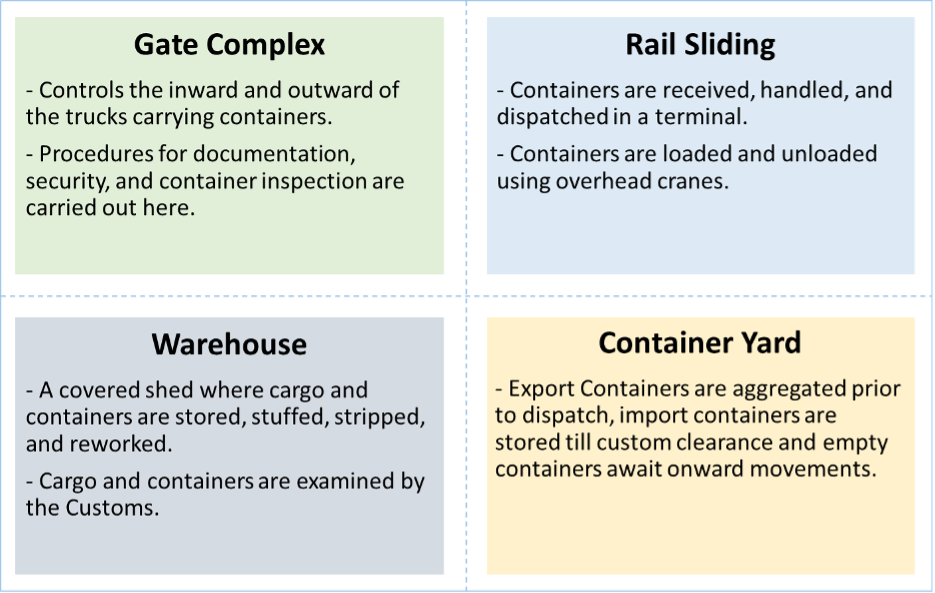
WHAT ARE THE IMPORTANT CENTERS OF ACTIVITIES RELATING TO ICD / CFS?
WHAT ARE THE CRITERIA FOR SETTING UP A NEW ICD / CFS / AFS?
Geographical Criteria:
- The country has been divided into three broad categories for the purpose of considering new proposals:
- Green Zone includes states and union territories with relatively lower ICD/CFS penetration and remains open for proposals.
- Blue Zone includes locations where proposals may be considered only in specific trade-generating areas with no existing facility or with over-utilised facilities.
- Red Zone covers states where ICD/CFS infrastructure is already considered adequate; in such locations, new CFS development is generally closed, although the IMC may still approve ICDs in exceptional trade-generating locations with strong import or export potential.
- The development of ICDs within 200 km of the connecting or nearest serving seaport is discouraged. The policy notes that rail-connected ICDs are typically favored at hinterland locations, particularly where the lead distance supports rail economics.
- No greenfield ICD should ordinarily be established within 100 km of an existing ICD. This distance test applies across geographical zones.
- Priority is intended to be given to states with limited logistics infrastructure, and the IMC may relax certain distance rules in Green Zone states.
- Approval and notification of new ICDs and CFSs, including facilities in or around MMLPs, are to be processed in consonance with the national logistics action plan or policy.
- ICDs based on Inland National Waterways may receive relaxation from geographical zone and distance rules.
- For ICDs directly linked to Dedicated Freight Corridors, the policy provides that not more than one ICD directly connected to the corridor should ordinarily be approved within a chargeable distance of 100 km in both directions.
- The IMC may allow additional facilities near existing ICDs or CFSs if demand materially exceeds existing capacity in the relevant trade-generating location. However, no new CFS linked to an ICD is to be permitted; only CFSs linked to ports in permissible zones may be considered, subject to capacity and utilisation analysis.
- In the case of AFSs, the IMC evaluates proposals largely on demand-supply considerations because AFSs remain a relatively newer category in India.
| ICD | CFS | AFS | |
|---|---|---|---|
| LOCATION | Located in the Hinterland. | Located near ports / terminals | Located near airports as off-terminal facilities |
| NATURE OF FACILITY | Self-contained Customs station for handling and clearance of import/export containers and cargo | Extension of a port or Customs station for stuffing, destuffing, consolidation and temporary storage | Off-airport facility for handling import/export cargo with Customs formalities |
| LAND | Minimum 7 hectares, including minimum Customs notified area and nominated DPD/DPE space; in Green Zone states, lower area may be considered subject to policy conditions | Minimum 2 Hectares. | Minimum 100 sq. meters of covered area each for imports and exports |
| VOLUME | 7,200 TEUs / consignments per year, two-way | 1,200 TEUs / consignments per year, two-way | No minimum threshold performance prescribed |
| CONNECTIVITY | Intended for inland aggregation and dispatch, typically rail- or road-linked to ports | Intended as an extension of port-linked logistics and cargo handling | Intended to decongest gateway airport cargo terminals and facilitate air cargo movement |
Other Criteria:
- Legal Entity: The applicant must be a legal entity in India under applicable law. The entity must possess a valid GST registration and should have been operating for a minimum period of three years.
- Prior experience: The applicant must have prior experience operating as Certified Cargo Screening Program (CCSP) or should have other trans-border logistics experience such as a logistics service provider including customs brokers, transporters, freight forwarders, shipping lines, and port terminal operators.
LAND OWNERSHIP AND APPLICANT ELIGIBILITY
In addition to traffic and geographical criteria, the applicant must have clear legal rights over the proposed land parcel. Where the land is leased rather than owned, the lease agreement is expected to be for 30 years. The land should also be contiguous, free from acquisition proceedings at the time of application, and supported by change-of-land-use approvals wherever required.
From the applicant side, the entity must be a legal entity in India, hold a valid GST registration, and have been in operation for at least three years. The policy also expects prior experience either as a Customs Cargo Service Provider or in cross-border logistics activities such as customs brokerage, freight forwarding, transport, shipping, or port terminal operations.
| Evaluating an ICD or CFS opportunity in India? Before committing to site finalization, customs and regulatory approvals, infrastructure planning, or major capital expenditure, it is important to assess commercial viability, cargo potential, compliance requirements, and implementation readiness. Hmsa Consultancy supports clients through structured feasibility studies, detailed project reports, business model assessment, and strategic advisory aligned to practical investment decisions. Share your requirements with us here. |
WHAT IS THE PROCEDURE TO APPLY FOR ICD / CFS?

The contents of the article are taken from the Policy and Guidelines for setting up Inland Container Depot (ICDs), Container Freight Stations (CFSs), and Air Freight Stations (AFSs).
Also Read: Comprehensive Guidelines for Customs Cargo Service Providers (CCSPs) Under the Customs Act, 1962