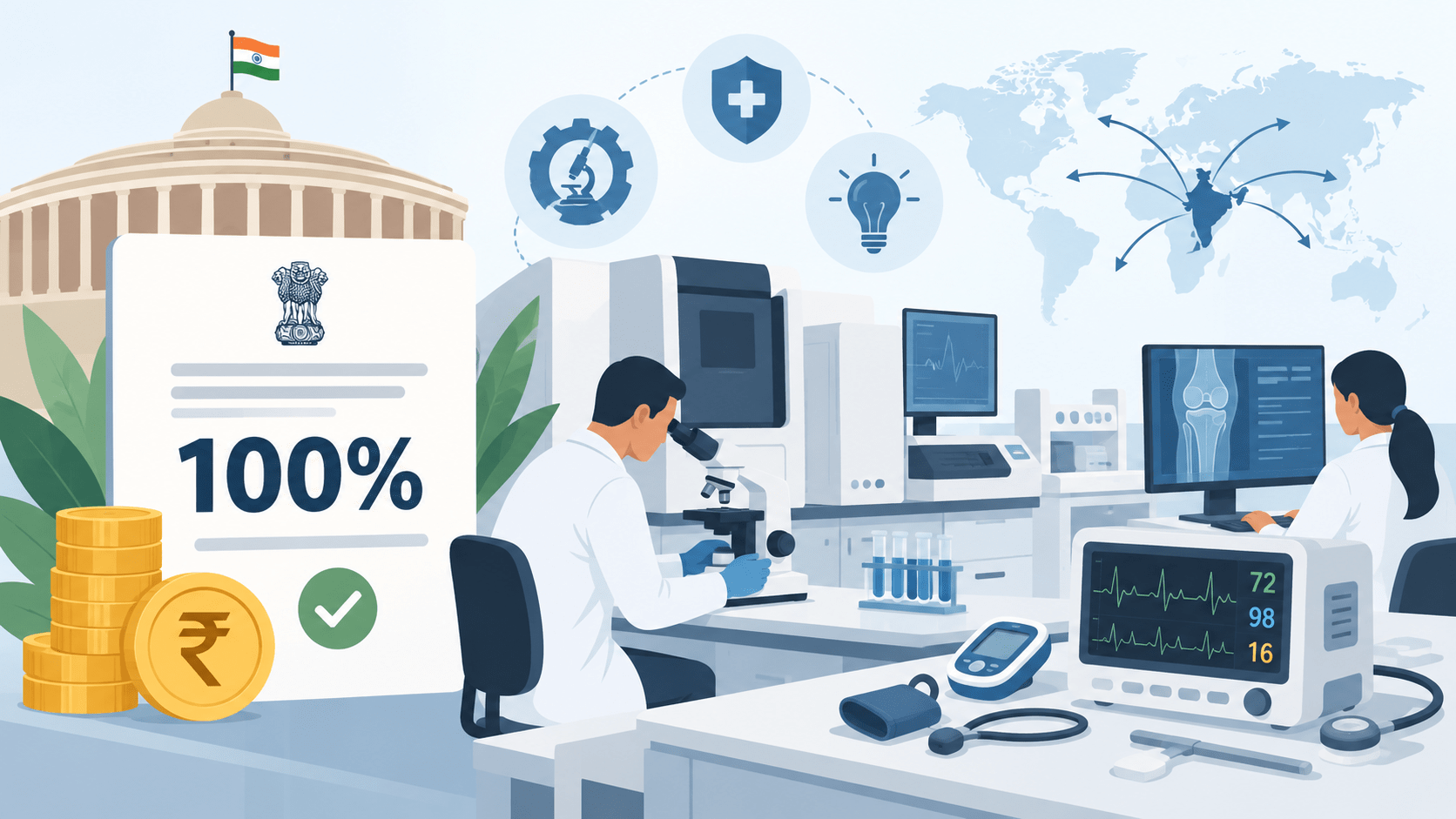
India’s efforts to expand domestic medical device manufacturing are increasingly extending beyond manufacturing capacity alone. Product design, testing, certification, intellectual property, research infrastructure and international quality standards are becoming equally important components of the wider MedTech ecosystem.
In September 2026, Union Minister of Commerce and Industry Piyush Goyal called for stronger medical-device testing infrastructure and indicated that the Government of India would support the acquisition of advanced technical testing equipment for shared facilities in government-sponsored or university laboratories. The statement was made while addressing the Pharma Machtech and Labnext Expo 2026 in New Delhi.
The announcement has subsequently been reported as the Government being prepared to provide 100% funding support for medical testing equipment. For organisations evaluating opportunities in medical-device testing, research infrastructure or related facilities, the development is relevant. However, it is equally important to distinguish the policy direction expressed by the Government from the detailed eligibility and financial conditions applicable to an actual project.
What Has the Government Announced?
The official Press Information Bureau release places the testing-infrastructure announcement within a broader strategy for strengthening India’s MedTech ecosystem.
The Minister called for the creation of shared testing infrastructure where Indian medical equipment could be tested, benchmarked against leading global products, certified and demonstrated to international customers. The Government, according to the PIB release, would support acquisition of advanced technical testing equipment for such facilities in government-sponsored or university laboratories.
The announcement was accompanied by a broader emphasis on:
- strengthening domestic capabilities in medical equipment;
- improving design, patents and the intellectual-property ecosystem;
- encouraging technology partnerships and joint ventures;
- promoting co-design, co-development and licensing;
- creating stronger connections between industry, academia and research institutions; and
- expanding India’s role in medical-device innovation and manufacturing.
This wider context is important. The policy objective appears to extend beyond financing laboratory equipment. It is directed towards developing an ecosystem capable of taking products from research and design through testing, validation, certification and eventual commercialisation.
Does This Mean Every Medical Device Company Can Obtain 100% Funding?
Not necessarily.
The newspaper report refers to willingness to support 100% of the cost of appropriate testing equipment. However, the official PIB communication does not establish a universal capital subsidy available directly to every medical-device manufacturer.
Instead, it specifically refers to government-sponsored or university laboratories and shared testing infrastructure.
Therefore, businesses considering projects based on the announcement should first establish:
- whether the proposed applicant falls within the eligible institutional categories;
- whether the proposed laboratory is intended as shared infrastructure or principally for captive use;
- which Indian Standards the proposed equipment would support;
- whether comparable testing facilities already exist;
- what part of the project cost may qualify for support; and
- what application, approval and implementation conditions would apply.
These questions become particularly important before incorporating any assumed grant or government support into a project’s financial model.
The Existing BIS Framework Provides Useful Context
The Bureau of Indian Standards already maintains guidelines for supporting other laboratories in the creation or augmentation of testing facilities in critical areas.
Under BIS’s revised guidelines, eligible organizations include laboratories owned or fully or partly funded by the Central Government, institutions of higher education, and private organizations operating laboratories for R&D purposes or on a not-for-profit basis.
The guidelines require applicants to submit information including:
- location and management of the proposed laboratory;
- relationship with the relevant government department or ministry;
- proposed testing facilities;
- details of existing testing infrastructure;
- Indian Standards associated with the proposed facilities;
- justification for creating the facility; and
- existing testing capacity and sample inflows where augmentation is proposed.
Consequently, the recent announcement should be evaluated alongside the prevailing BIS framework and any subsequent notifications, amendments or implementation guidelines.
Why Testing Infrastructure Is Important for India’s Medical Device Industry
Manufacturing a medical device and successfully commercialising it are different stages of the value chain.
Medical devices can require extensive testing relating to safety, performance, electrical systems, electromagnetic compatibility and other product-specific parameters. BIS maintains a network comprising its own laboratories as well as recognized and empanelled laboratories supporting conformity-assessment requirements.
Testing can also represent a meaningful component of product-development cost.
For illustration, BIS laboratory information for different categories of medical electrical equipment shows substantial variation in testing requirements and charges depending upon the applicable standard and test scope. Testing requirements may include electrical safety, mechanical hazards, electromagnetic compatibility and other device-specific parameters.
Strengthening domestic testing capacity can therefore contribute to several objectives.
Faster Product Development
Accessible testing facilities can enable manufacturers and product developers to undertake validation closer to their development and manufacturing locations.
Improved Product Quality
Testing infrastructure allows devices to be systematically evaluated against defined technical requirements rather than relying only on internal validation.
Support for Certification
Laboratories capable of conducting tests against applicable standards are an important component of the certification and conformity-assessment ecosystem.
Better Product Benchmarking
The Government has specifically highlighted the need to benchmark Indian equipment against leading international products.
Support for Export Readiness
While establishing a testing facility in India does not by itself provide access to international markets, stronger product validation, certification capabilities and internationally comparable infrastructure can form part of a wider export-readiness strategy.
Where Could the Opportunity Develop?
The announcement could have implications across several parts of the healthcare and MedTech ecosystem.
Shared Medical Device Testing Laboratories
Institutions with appropriate eligibility, technical capabilities and sufficient industry demand could evaluate specialised laboratories catering to clusters of medical-device manufacturers.
A shared facility can potentially avoid duplication of highly specialised equipment that may not achieve adequate utilisation within an individual manufacturer’s captive laboratory.
Universities and Research Institutions
Universities developing medical technology, biomedical engineering or healthcare innovation capabilities could evaluate testing infrastructure that connects academic research with commercial product development.
The Government’s official communication specifically refers to university laboratories, making this an important area to monitor as implementation mechanisms become clearer.
Medical Device Manufacturing Clusters
Testing infrastructure can form part of the common infrastructure supporting specialised manufacturing ecosystems. The commercial case, however, depends on the number of manufacturers, type of devices produced and testing requirements generated by the cluster.
Technology and Equipment Providers
Expansion of testing infrastructure can also create opportunities for suppliers of specialised testing systems, calibration equipment, laboratory technologies, software and associated technical services.
Collaborative R&D Centres
The Government has separately encouraged collaboration among industry, academia, medical colleges, IITs and other centres of excellence, as well as collaboration with overseas R&D centres.
Testing facilities could therefore increasingly be planned as part of integrated research, prototyping, validation and commercialisation infrastructure, rather than as standalone laboratories.
A Testing Laboratory Still Requires a Commercial and Technical Case
Government support can improve project economics, but it does not by itself establish whether a testing facility should be developed.
A proposed laboratory should be assessed across several dimensions before capital expenditure is committed.
1. Demand for Testing
The starting point should be identification of the medical devices being manufactured or developed in the intended catchment area and the corresponding standards and testing requirements.
2. Existing Testing Capacity
Existing BIS, recognized and empanelled laboratory capabilities should be assessed to determine whether the proposed facility addresses a genuine capacity or capability gap. BIS maintains searchable information regarding recognized laboratories and their testing scope.
3. Equipment Configuration
The proposed laboratory should be designed around clearly identified testing requirements rather than around equipment availability alone.
4. Utilisation
Sophisticated testing equipment can involve significant capital expenditure. Forecast utilisation therefore becomes important even where equipment acquisition receives financial assistance.
5. Operating Economics
Manpower, calibration, maintenance, consumables, utilities, accreditation, software and equipment replacement need to be considered separately from initial capital expenditure.
6. Institutional Structure
The appropriate structure may differ depending on whether the facility is operated by a university, research institution, government-supported entity, industry association or another eligible organisation.
7. Certification and Recognition
Funding for equipment should not be confused with approval of the laboratory itself. Applicable accreditation, recognition, quality systems and technical requirements need to be independently evaluated.
The Strategic Opportunity Goes Beyond Laboratory Equipment
The broader significance of the recent announcement lies in the Government’s emphasis on building a more complete domestic medical-device ecosystem.
The official statement links testing infrastructure with innovation, intellectual property, R&D, technology transfer, joint ventures, manufacturing quality and international market access. The Minister also referred to a ₹1 lakh crore commitment towards research, development, innovation and funding, while encouraging stakeholders to use available opportunities for development of newer equipment, drugs and medicines.
For businesses evaluating the sector, this suggests that medical-device projects should increasingly be considered across the full value chain:
product identification → technology → design → intellectual property → prototyping → testing → certification → manufacturing → commercialisation → international market access.
This has important consequences for project planning. A proposed medical-device manufacturing investment should not be assessed only in terms of plant capacity, machinery and production cost. Availability of technology, testing infrastructure, regulatory pathways, clinical requirements, intellectual property, market acceptance and certification can materially affect both project timelines and commercial viability.
| Planning a Medical Device Manufacturing or Testing Infrastructure Project? Before developing a medical-device manufacturing facility, testing laboratory or shared MedTech infrastructure project, it is important to establish the applicable testing requirements, potential demand, standards coverage, institutional eligibility, equipment configuration, project cost, operating model and financial viability. Hmsa Consultancy Services supports such evaluations through structured feasibility studies, detailed project reports, market and demand assessment, project configuration, financial modelling, policy and incentive assessment and implementation planning aligned with actual investment decisions. Organizations evaluating a proposed medical-device or testing-infrastructure project can engage Hmsa to assess the opportunity before committing capital or proceeding with an application. You may reach out here. |
How Hmsa Consultancy Services Can Support Medical Device Testing and Manufacturing Projects
Hmsa Consultancy Services can support organisations evaluating medical device testing and manufacturing projects through feasibility studies, detailed project reports, market and demand assessment, policy and eligibility review, project configuration, financial modelling, and implementation planning. For testing infrastructure, the assessment can cover target device categories, applicable standards, existing laboratory capacity, equipment requirements, utilisation potential, operating economics, and funding structure. For manufacturing projects, Hmsa can additionally evaluate product opportunities, technology requirements, location options, project cost, business viability, and potential partnership or licensing models, helping clients assess the commercial and financial case before committing capital.
Conclusion
The Government’s stated willingness to support advanced medical-device testing infrastructure is an important development for India’s evolving MedTech ecosystem. It reflects a broader policy emphasis on strengthening product quality, testing, innovation, domestic capabilities and international competitiveness.
However, the headline of 100% funding should be interpreted carefully. The official communication presently refers specifically to supporting advanced testing equipment for government-sponsored or university laboratories, while existing BIS guidelines contain defined eligibility and proposal requirements.
For institutions and businesses considering investments in this area, the appropriate next step is therefore not simply to assume availability of funding. It is to establish eligibility, testing demand, standards coverage, infrastructure requirements, operating economics and implementation feasibility before proceeding with the project.
Reference: PIB