
Hospitality and Tourism Opportunity Landscape
Market Overview and Growth Potential
India’s tourism opportunity is being broadened by changing traveler behavior. Domestic travelers are increasingly looking for shorter, experience-led trips, which is strengthening demand for curated heritage circuits, nature-based stays, adventure activities, and destination experiences close to major urban centers. Simultaneously, improving air connectivity and highway infrastructure continues to reshape what is considered a viable weekend and short-break destination, particularly across Tier-2 and Tier-3 cities.
The sector is also benefiting from diversification of demand. Beyond leisure travel, there is rising interest in wellness retreats, cultural immersion, spiritual tourism, weddings and events, and “workation” formats that combine work and leisure. This demand variety typically improves the business case for accommodation assets when the product mix is designed to manage seasonality and improve year-round occupancy.
India’s tourism and accommodation sector is experiencing strong growth, driven by government initiatives, increasing domestic and international travel, and investments in infrastructure. The Union Budget 2025-26 has emphasized:
- Development of heritage and eco-tourism destinations
- Expansion of tourism infrastructure, including roads, airports, and hotels
- Promotion of medical and wellness tourism
Key Market Indicators:
Market indicators are best used as directional signals for feasibility, rather than treated as guaranteed outcomes, because projections vary by definition and methodology. However, the broad trend is consistent: tourism demand is expanding, infrastructure is improving, and the range of commercially viable destinations is widening beyond traditional metropolitan and legacy tourist centres.
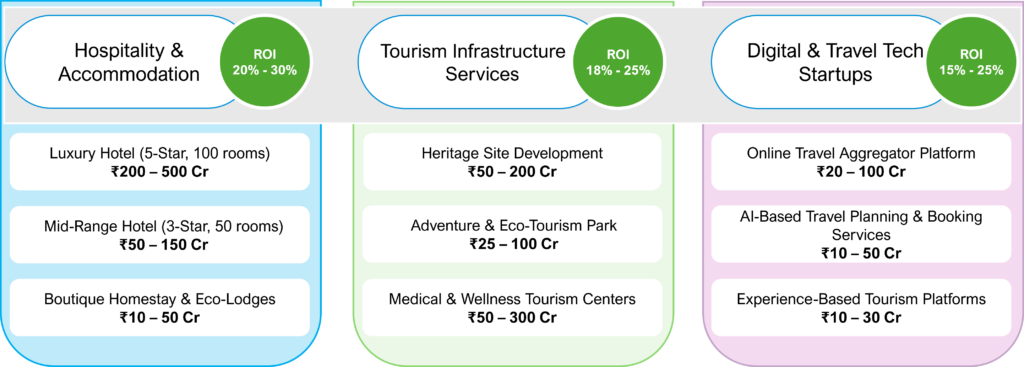
For investors and promoters, the practical implication is that opportunity is shifting from “only prime city hotels” toward differentiated destination products, including mid-scale business hotels in emerging cities, experiential resorts, branded homestays, eco-tourism properties, medical travel facilitation, and technology-led distribution platforms. A robust feasibility study typically tests these indicators against micro-market fundamentals such as location catchment, accessibility, competing supply, price positioning, and realistic ramp-up timelines.
- India’s tourism sector projected to reach $500 billion by 2030
- Domestic travel market expected to grow at 15% CAGR
- Foreign tourist arrivals to exceed 20 million by 2030
- ₹10,000 crore allocated for tourism infrastructure development
Government Policies and Budgetary Support
Policy support matters most when it reduces friction in project development and improves destination readiness. In tourism, destination readiness is not only about attractions, but also last-mile connectivity, safety, sanitation, signage, parking, and availability of quality accommodation and services. Even where incentives are available, the investment attractiveness ultimately improves when the surrounding ecosystem reduces execution risk and increases visitor satisfaction.
Budget 2025-26 Incentives:
- ₹10,000 crore allocation for tourism infrastructure
- Tax breaks for eco-tourism and heritage site operators
- Subsidies for hotel development in Tier-2 and Tier-3 cities
- Ease of doing business reforms for travel and hotels startups
Key Challenges and Risks
Capital intensity can create pressure on break-even timelines, especially when projects are over-designed relative to realistic demand, or when development costs escalate due to design changes, contractor issues, or delays in approvals. As a result, the feasibility case must be built with disciplined sizing, careful phasing, and conservative ramp-up assumptions, particularly for greenfield destination resorts.
- High capital expenditure for luxury hotels and large tourism projects
- Seasonal demand fluctuations affecting occupancy rates
- Regulatory and environmental approvals for eco-tourism projects
- Competition from established international travel destinations
Implementation Roadmap
Short-Term (0-2 Years)
- Identify prime locations and secure land for hotel projects
- Develop partnerships with state tourism boards and private investors
- Launch pilot tourism experiences focused on eco and heritage tourism
Medium-Term (2-5 Years)
- Scale up hotel and tourism infrastructure development
- Expand digital platforms for travel bookings and experiences
- Promote India as a global wellness and adventure tourism destination
Long-Term (5+ Years)
- Develop globally competitive luxury and sustainable tourism hubs
- Strengthen India’s position in medical and wellness tourism
- Enhance integration of AI and digital solutions in tourism services
Conclusion
India’s tourism & hospitality sector presents high-growth investment opportunities. With strong government support, increasing travel demand, and evolving consumer preferences, businesses can establish scalable, profitable ventures in hotels, eco-tourism, and digital travel solutions.
Reach out to us by filling the form to get a project report / feasibility study done to start a business in this sector.