What if your company’s growing sales are actually contributing to declining profits?
Imagine a company that has achieved 30% revenue growth during the year. Its sales team has exceeded targets, several new customers have been acquired, production volumes have increased, and management is considering further expansion.
On the surface, the business appears to be performing well.
However, when the annual financial results are reviewed, the picture is considerably less encouraging.
Operating profits have declined. Working capital requirements have increased. Borrowings have risen, and despite achieving record sales, the company is generating less cash than expected.
How can a business sell substantially more and yet become less profitable?
The answer lies in a distinction that is frequently overlooked in business performance reviews.
Revenue growth measures how much more a company sells. Profitable growth measures how much additional economic benefit the company derives from those sales.
The two are related, but they are not interchangeable.
Understanding this distinction is essential for business owners, CEOs and management teams seeking sustainable growth rather than merely larger businesses.
Revenue Growth and Profitability: Why the Relationship is Not Automatic
Revenue growth is generally desirable.
When a company increases sales while maintaining attractive margins and controlling costs, additional revenue can generate higher profits. Greater volumes may also improve capacity utilisation, purchasing efficiency and the absorption of fixed costs.
Indeed, research supports the proposition that well-managed growth and profitability can reinforce each other.
A 2024 study examining 837 publicly traded Indian companies over the period 2012–2022 found a strong positive correlation between revenue growth and profit growth. The study reported a correlation coefficient of 0.95, indicating that companies achieving higher revenue growth generally also experienced stronger profit growth.
However, this relationship does not establish that every additional sale improves a company’s profitability.
The financial outcome depends on the economics of the additional business.
Consider a company that increases revenue by aggressively discounting its products. Sales volumes may rise, but the reduction in selling prices could significantly erode margins.
Similarly, a company entering a new geographical market may incur additional distribution, warehousing, marketing and administrative expenses that absorb much of the contribution generated by new sales.
Another business may acquire large customers by offering extended credit periods, creating substantial working capital requirements and additional financing costs.
In each situation, revenue growth may be genuine, but its financial benefits may be considerably smaller than anticipated.
The critical question is therefore not simply whether revenue is growing.
It is whether additional revenue is generating sufficient incremental profit and cash flow to justify the resources required.
How 30% Revenue Growth can Result in Declining Profits
Consider a hypothetical manufacturing company with annual revenue of ₹100 crore.
The company generates a contribution of ₹25 crore after meeting the variable costs associated with production and sales.
Its annual fixed operating expenses amount to ₹18 crore, resulting in EBITDA of ₹7 crore.
Management decides to pursue aggressive expansion by entering new markets and acquiring additional customers.
During the following year, the company successfully increases revenue by ₹30 crore, representing growth of 30%.
However, the additional business is secured at lower margins because of competitive pricing, distributor incentives and higher logistics expenses.
The new revenue contributes only 12% towards covering fixed costs and generating profits.
Consequently, the additional ₹30 crore of revenue generates an incremental contribution of ₹3.6 crore.
To support the expansion, the company also establishes new distribution arrangements, recruits additional personnel and incurs other fixed operating expenses amounting to ₹5 crore annually.
The financial outcome is revealing.
Revenue increases from ₹100 crore to ₹130 crore.
However, EBITDA declines from ₹7 crore to ₹5.6 crore.
The company has achieved 30% revenue growth while experiencing a 20% reduction in EBITDA.
This illustration is hypothetical, but the underlying economics are straightforward.
The additional sales generated a positive contribution. Nevertheless, that contribution was insufficient to cover the incremental fixed costs required to support the expansion.
The critical management failure was not necessarily the decision to grow.
It was the failure to establish whether the additional business would generate adequate returns after considering the full incremental cost of growth.
There is another important consideration.
If management expects profitability to improve as volumes increase further, the expansion may still prove commercially justified.
But that expectation must be supported by a credible assessment of market demand, achievable margins, future costs and the sales volume required to recover the additional expenditure.
Growth should not be justified merely on the assumption that profits will eventually follow.
The Hidden Reasons Why Increasing Sales May Reduce Profitability
Companies experiencing declining profitability during periods of revenue growth frequently begin by examining production costs, manpower expenses and administrative overheads.
While these areas warrant attention, the underlying causes may lie elsewhere.
In many businesses, profitability begins to deteriorate through decisions made long before the resulting costs become visible in the financial statements.
When Sales Growth Is Purchased Through Lower Prices
One of the most common reasons for declining profitability is the pursuit of additional sales through aggressive pricing.
A company facing competitive pressure may offer substantial discounts to secure large orders, enter new markets or retain major customers.
The sales team may consider these transactions successful because they increase revenue and strengthen customer relationships.
However, the profitability implications can be substantial.
For example, a product selling for ₹1,000 with variable costs of ₹800 generates a contribution of ₹200.
If the selling price is reduced by 10% to ₹900, the contribution falls to ₹100, assuming variable costs remain unchanged.
The selling price has declined by only 10%, but the contribution per unit has fallen by 50%.
The company must now sell twice as many units merely to maintain the original total contribution.
Additional volumes may require greater production capacity, higher logistics expenditure and increased working capital.
Thus, what appears to be a relatively modest pricing concession can create a disproportionately large profitability challenge.
The management implication is significant.
Sales targets should not encourage teams to generate additional revenue without considering the contribution earned from that revenue.
When More Customers Mean Higher Servicing Costs
Companies often assume that acquiring larger customers or increasing order volumes will improve economies of scale.
This is not necessarily true.
Different customers can impose very different costs on an organisation.
One customer may place large, standardised orders, maintain predictable purchasing schedules and make payments within agreed credit periods.
Another customer may generate similar revenue but require frequent small deliveries, customised products, urgent dispatches, additional technical support, frequent order modifications and extended credit.
Both customers may appear equally attractive in a revenue report.
However, their economic contribution can be considerably different.
A company that evaluates customer profitability using only selling price and direct product cost may overlook substantial differences in logistics, servicing, quality assurance and administrative requirements.
Consequently, a growing customer base may lead to declining profitability if the new business is disproportionately expensive to service.
This is especially relevant in manufacturing, distribution, logistics and business-to-business services, where customer-specific requirements can significantly influence operating costs.
Management should therefore evaluate profitability at a more granular level, considering products, customers, geographical markets and distribution channels.
A growing customer relationship is valuable only when its present or reasonably expected future economics justify the resources committed to it.
When the Organisation Becomes More Complex Than Its Revenue Can Support
As businesses expand, their operating requirements become more demanding.
Additional customers may require more employees, greater supervision, new systems, additional warehouses, expanded production facilities or greater management oversight.
Some of these costs increase gradually with sales volumes.
Others increase in substantial increments when the organisation crosses a capacity threshold.
For example, a manufacturing company operating at 70% capacity may accommodate additional orders without significantly increasing its fixed costs.
However, once production approaches its capacity limits, further growth may require another production line, additional shifts, specialised personnel or investment in new equipment.
The economics of growth can change dramatically at this point.
A business that previously generated attractive incremental margins may temporarily experience lower profitability as new capacity is commissioned and utilised.
The same principle applies to service businesses.
A consulting, engineering or technology company may initially accommodate additional assignments using its existing resources. Beyond a certain point, however, it must recruit more employees, strengthen management supervision and invest in systems and infrastructure.
These expenses may arise before the corresponding revenue reaches its expected level.
The critical management requirement is to understand where the next significant increase in operating costs will occur and whether anticipated revenue will justify it.
Failure to examine these thresholds can cause businesses to underestimate the true cost of expansion.
Profitability Can Improve While Cash Flow Deteriorates
There is another dimension of growth that deserves equal attention.
Even when additional revenue generates higher accounting profits, the company’s financial position may weaken if growth requires disproportionate investment in working capital.
Consider a manufacturing business that receives a substantial increase in orders.
To fulfil these orders, it must purchase additional raw materials, maintain higher inventories and extend credit to customers.
The associated expenditure may occur well before the company receives payment for its sales.
Consequently, the business may report higher revenue and profits while experiencing increasing cash shortages.
The situation becomes more challenging when customers negotiate longer payment terms or when inventory accumulates because production and sales forecasts are poorly coordinated.
Additional borrowings may then be required to finance operations.
Interest costs reduce net profitability, while increasing debt can expose the company to liquidity and financial risks.
This creates a situation in which reported growth conceals a deterioration in financial resilience.
Management must therefore distinguish between three different outcomes: increasing revenue, increasing accounting profitability and improving cash generation.
These outcomes are related, but they are not equivalent.
A business that generates higher profits while continuously requiring disproportionate additional capital may not be creating sufficient economic value.
This is why working capital efficiency and returns on incremental invested capital deserve attention alongside conventional revenue and profitability measures.
Are Management Incentives Encouraging Revenue at the Expense of Profits?
One of the more important, yet frequently overlooked, causes of unprofitable growth lies in organisational performance measurement.
Consider how responsibilities are typically distributed within a company.
The sales department is accountable for revenue targets.
The production department focuses on output, utilisation and manufacturing efficiency.
The procurement department seeks to optimise purchasing costs.
The finance department monitors profitability, cash flows and financial controls.
Each department may perform satisfactorily against its individual targets while the company’s overall financial performance deteriorates.
For example, the sales team may secure additional orders by offering discounts and extended credit.
Production may then be required to accommodate smaller production batches, frequent changeovers or urgent delivery schedules.
Procurement may face higher costs because of unplanned material requirements.
Finance must arrange additional working capital to support the resulting increase in receivables and inventories.
Individually, each department is responding to its responsibilities.
Collectively, however, the decisions may reduce the profitability of the business.
This is not merely a financial reporting problem.
It is a management alignment problem.
If employees are rewarded primarily for increasing sales volumes, management should not be surprised when revenue growth receives greater attention than contribution margins or cash realisation.
Companies should therefore examine whether their performance measurement and incentive systems encourage decisions that improve enterprise-level profitability.
This does not mean replacing revenue targets entirely with profit targets.
Rather, sales growth objectives should be complemented by measures such as contribution margins, pricing realisation, customer profitability, collection performance and the costs associated with servicing different market segments.
Cross-functional accountability is essential because many profitability problems originate from decisions spanning multiple departments.
When Lower Profitability During Growth may be Justified
Not every decline in profitability during a growth phase indicates poor management.
Some investments create costs before they generate their full commercial benefits.
A company entering a promising new market may initially incur significant marketing and distribution expenses.
A manufacturer establishing new production capacity may experience low utilisation during the initial operating period.
A technology business may spend heavily on product development before achieving a commercially viable customer base.
In such circumstances, management may deliberately accept lower short-term profitability in pursuit of stronger future earnings.
The critical distinction is between temporary profitability pressure resulting from justified investment and persistent margin deterioration resulting from an uneconomic business model.
A credible growth plan should establish when the investment is expected to achieve commercial maturity, what operational milestones must be attained and how profitability is expected to improve.
Management should be able to explain the required sales volumes, contribution margins, customer retention levels, capacity utilisation and cost efficiencies supporting its projections.
More importantly, actual performance should be periodically compared with these assumptions.
If market demand is weaker than anticipated, customer acquisition costs remain elevated or profitability fails to improve despite increasing scale, the underlying growth strategy may require reconsideration.
Continuing to invest merely because substantial expenditure has already been incurred can compound the problem.
Growth investments should be evaluated on the basis of their expected future economic contribution, rather than defended solely because they formed part of the original expansion plan.
Measure How Revenue Converts into Profit
In our view, the central management challenge is not choosing between revenue growth and profitability.
It is understanding why additional revenue does, or does not, translate into additional profit and cash flow.
This requires a more integrated approach to performance assessment.
We believe companies experiencing declining margins despite increasing sales should undertake a structured Revenue-to-Profit Diagnostic Assessment.
The starting point should be to establish how much additional revenue has been generated and where that growth originated.
Management should distinguish between increases arising from higher sales volumes, improved selling prices, changes in product mix, new customers and entry into additional markets.
This distinction matters because different sources of revenue growth have different profitability implications.
The next step is to determine the contribution generated by incremental business.
Rather than relying exclusively on company-wide gross profit margins, management should examine whether additional products, customers and markets are generating adequate contribution after relevant variable costs.
The assessment must then consider the additional costs required to support growth.
These may include logistics, manpower, supervision, marketing, distribution, quality assurance, systems and infrastructure.
Particular attention should be given to costs that increase in steps as the organisation expands.
Management should also examine the impact of revenue growth on inventories, receivables, borrowings and cash generation.
Finally, the assessment should identify the organisational decisions responsible for profitability outcomes.
Are sales teams permitted to approve discounts without sufficient financial evaluation? Are customer servicing requirements appropriately reflected in pricing? Are production and sales plans sufficiently coordinated? Do departmental targets encourage profitable growth?
These questions help establish whether the problem arises from market conditions, commercial decisions, operational inefficiencies, organisational structures or inadequate management information.
The Importance of a Revenue-to-Profit Bridge
A particularly useful management tool is a financial bridge explaining the movement from the previous period’s operating profit to the current period’s operating profit.
Such an analysis should distinguish the effects of sales volumes, price realisation, product and customer mix, changes in direct costs, operational productivity, incremental overheads and expansion-related expenditure.
For example, a company’s revenue may have increased significantly because of higher volumes.
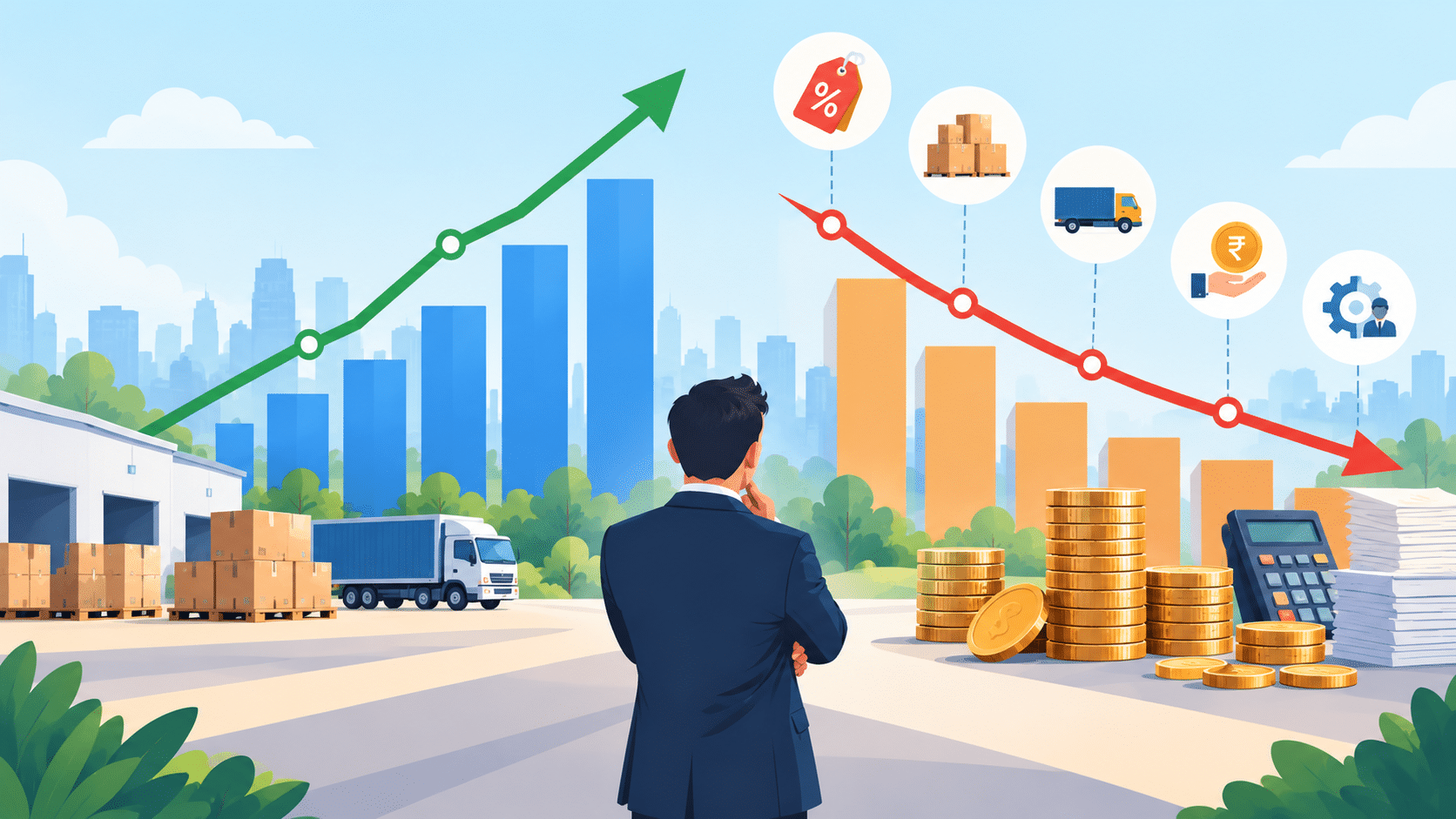
However, a closer examination may reveal that the additional contribution was offset by lower selling prices, a shift towards less profitable products, higher logistics costs and additional fixed operating expenses.
Without this analysis, management may respond to declining profitability through indiscriminate cost reduction.
Such measures can inadvertently affect product quality, customer service or capabilities required for future growth.
A structured diagnostic enables management to identify the actual sources of margin erosion and prioritise corrective actions.
The objective should not be to reduce expenditure indiscriminately.
It should be to improve the economic contribution of revenue while preserving the capabilities necessary for sustainable growth.
Profitable Growth Requires an Integrated Management Approach
Companies seeking sustainable improvement should move beyond evaluating revenue growth and profitability as separate management objectives.
Growth plans must be supported by commercial assessments, operational capacity planning, organisational readiness and financial evaluation.
Sales forecasts should be examined alongside achievable margins and customer servicing requirements.
Expansion plans should consider capacity constraints, productivity, manpower requirements and infrastructure costs.
Financial projections should incorporate working capital requirements, financing costs and returns on incremental capital.
Performance measurement systems should encourage coordinated decisions across sales, operations and finance.
Most importantly, management should periodically evaluate whether the assumptions supporting the growth strategy remain valid.
This requires an effective management information system that provides visibility not merely into sales and aggregate profits, but also into the underlying drivers of financial performance.
Companies that understand these relationships are better positioned to identify which opportunities deserve further investment, which products or customers require corrective action and where operational improvements can generate greater returns.
A Bigger Business is not Necessarily a Better Business
Revenue growth is an important indicator of business expansion, market acceptance and commercial progress.
However, it should not be treated as an end in itself.
A company may increase sales, expand its geographical presence and acquire more customers while simultaneously weakening its margins, stretching its financial resources and increasing operational complexity.
Conversely, a business that grows at a more measured pace, improves its product mix, strengthens pricing discipline and increases operational efficiency may generate superior profits and cash flows.
The objective is not to discourage growth.
It is to ensure that growth is commercially attractive, operationally manageable and financially sustainable.
For promoters, CEOs and business leaders, this requires a fundamental shift in how business performance is evaluated.
The question should not end with “How much has our revenue increased?”
It must extend to “How much additional profit and cash has that growth generated, and what resources have we committed to achieve it?”
Ultimately, the success of a growth strategy should be measured not merely by the size of the business it creates, but by the sustainable economic value that business generates.
And this raises an important question for business leaders:
When your company achieves its annual revenue target but misses its profitability target, does management investigate the underlying economics of growth, or simply set a higher revenue target for the following year?