
India’s revised Index of Industrial Production (IIP), with 2022-23 as the new base year, is an important statistical update for the country’s industrial economy. At first glance, the change may appear relevant mainly to economists, policymakers, analysts, and government departments. However, for business promoters, particularly those evaluating new projects, expansion plans, diversification opportunities, or sector entry decisions, the new IIP series can become a useful decision-support tool.
It is important to clarify at the outset that the new IIP series is not a subsidy scheme, incentive programme, tax benefit, or direct financial support mechanism. It does not provide promoters with capital assistance, concessional finance, preferential approvals, or automatic project-level benefits. Its value lies elsewhere. The revised IIP series improves the quality, relevance, and granularity of industrial data available in India. For promoters, this can support better business planning, stronger feasibility assessment, more credible investor communication, and more informed strategic decision-making.
Understanding the Relevance of IIP for Promoters
The Index of Industrial Production is a high-frequency indicator used to measure changes in the volume of industrial production over time. It tracks industrial activity across key sectors and provides an indication of whether production in a particular segment is expanding, slowing, or contracting.
For a promoter, this matters because industrial investment decisions are rarely made in isolation. A new manufacturing unit, mineral processing project, renewable energy-linked facility, waste management business, gas infrastructure venture, or industrial services project must be assessed in relation to broader sector trends. If the underlying industry is expanding steadily, the business case may be different from a sector where production is stagnant or highly volatile.
The revised IIP series, by updating the base year from 2011-12 to 2022-23, attempts to reflect the current structure of India’s industrial economy more accurately. This is relevant because India’s manufacturing, energy, infrastructure, and industrial services landscape has changed significantly over the last decade. Newer sectors have become commercially relevant, while some older product categories have become less representative of current industrial activity.
| Recent Update: On 20 July 2026, the Government released the revised Index of Core Industries (ICI) with 2022–23 as its base year, replacing the earlier 2011–12 series. The revised ICI covers nine industries: coal, crude oil, natural gas, refinery products, fertilizers, steel, cement, electricity and iron ore. Iron ore has been newly included because of its extensive use in industrial production and its contribution to industrial development. The revised methodology also uses gross production data for steel instead of net production data and retains only raw coal, excluding washed coal and coal middlings to avoid double counting. The weights assigned to the nine core industries have been derived from the corresponding items in the revised IIP series, creating closer methodological consistency between the two indicators. The first release under the new series showed ICI growth of 5.0% year-on-year in June 2026, with iron ore production increasing by 43.9%. For businesses, the revised ICI provides a more current reference for assessing activity across critical energy, mineral, infrastructure and basic-material sectors. |
Better Sector Visibility for New Business Opportunities
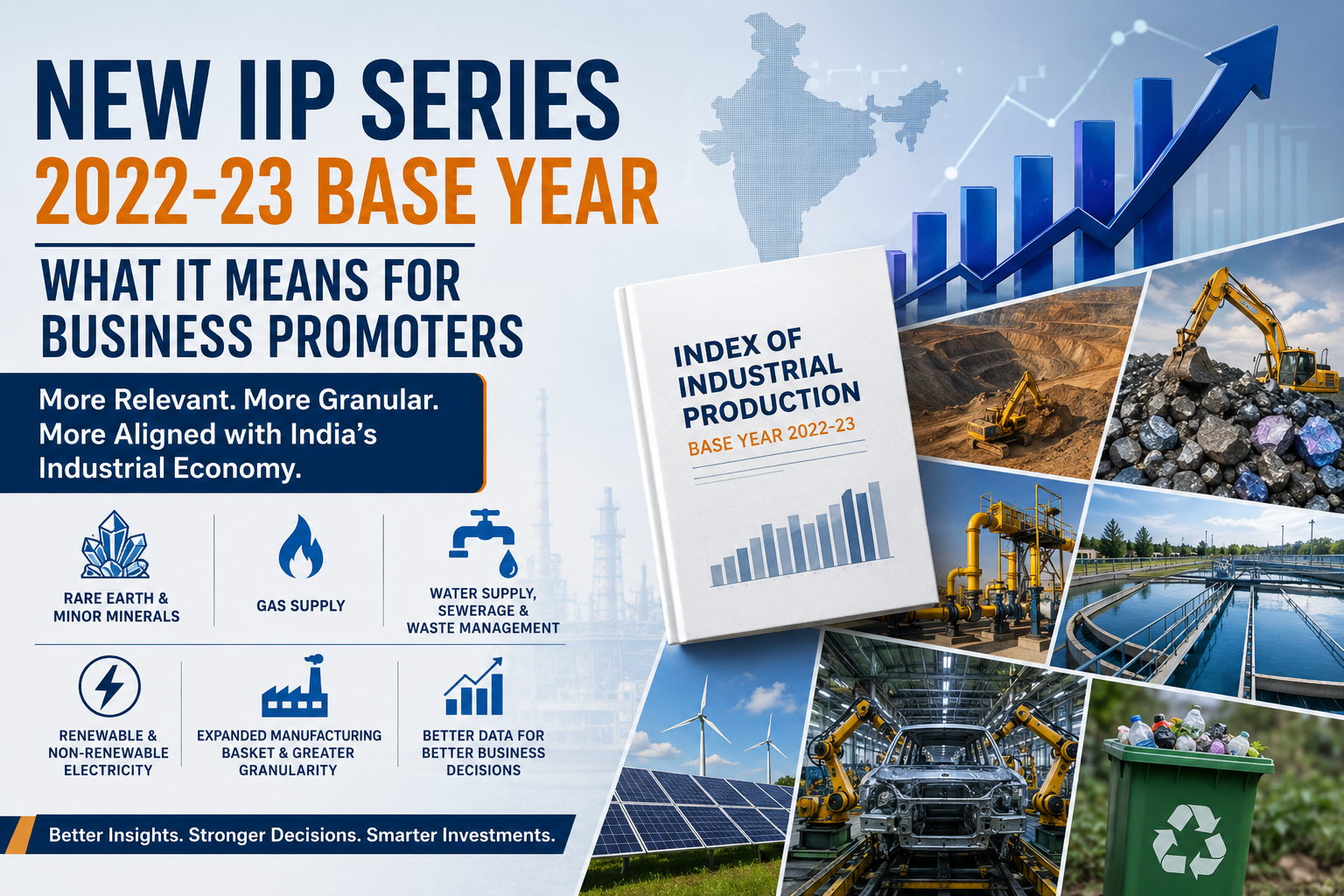
One of the most important benefits of the revised IIP series is improved sector visibility. The new series expands coverage to areas such as rare earth minerals, minor minerals, gas supply, water supply, sewerage, and waste management. It also introduces more granular tracking of electricity generation from renewable and non-renewable sources.
For promoters evaluating opportunities in these areas, this is useful. Many of these sectors are directly linked to India’s current policy and investment priorities. Rare earth minerals are relevant to electronics, electric mobility, defence, renewable energy equipment, advanced manufacturing, and critical mineral security. Gas supply is relevant to industrial fuel transition, city gas distribution, and energy infrastructure. Water supply, sewerage, and waste management are linked to urban infrastructure, industrial parks, municipal services, sustainability, and environmental compliance.
Earlier, some of these activities were either not covered or were not visible with sufficient granularity in the industrial production framework. Their inclusion in the revised IIP series indicates that they are now important enough to be tracked more systematically. For business promoters, this does not automatically confirm commercial viability, but it does help identify sectors that are gaining greater statistical and policy relevance.
Stronger Inputs for Feasibility Studies and Project Reports
Promoters planning a new project generally need to prepare feasibility studies, detailed project reports, business plans, investor presentations, or lender-facing documents. These documents require credible support for market demand, sector growth, investment rationale, and capacity planning.
The revised IIP series can help strengthen such analysis. Since the item basket has been updated and aligned more closely with the current industrial structure, the data can provide a more relevant basis for sector benchmarking. For example, a promoter evaluating a renewable energy equipment project may benefit from separate tracking of renewable electricity generation. A promoter assessing a waste processing project may benefit from better visibility into waste management as a tracked activity. A company considering mineral processing may find value in more granular mining and mineral classification.
This is particularly important in feasibility work because many project reports suffer from weak demand justification. Promoters often rely on broad industry commentary, supplier estimates, or generic market statements. A more representative IIP series can help improve the analytical base by providing an official statistical reference for industrial production trends.
However, IIP data should not be used as the only basis for project viability. It should be combined with customer demand assessment, competitive mapping, pricing analysis, raw material availability, policy incentives, infrastructure readiness, technology evaluation, operating cost assessment, and financial modelling.
Improved Investor and Lender Communication
Investors, banks, financial institutions, and strategic partners usually assess whether a proposed business is aligned with broader industrial trends. A promoter who can support the business case with updated industrial data is better placed to present a structured and credible investment rationale.
For example, if a promoter is proposing a project in renewable energy-linked manufacturing, waste management, mineral processing, or industrial utilities, the revised IIP series can help demonstrate that the sector is now being tracked more systematically within India’s industrial data framework. This can support the broader narrative around sector relevance, though it will not replace project-specific commercial validation.
For lenders, the revised IIP series may also provide an additional macro-level reference point while evaluating sector performance. Banks will still focus on promoter capability, security, project cost, debt servicing capacity, cash flow projections, approvals, offtake arrangements, and risk mitigation. However, official sectoral data can strengthen the overall project documentation.
Better Benchmarking for Existing Businesses
The benefits of the new IIP series are not limited to new projects. Existing business promoters can also use the revised data for performance benchmarking.
If a company’s sales or production growth is consistently below the relevant industry trend, it may indicate internal issues such as product competitiveness, pricing pressure, distribution limitations, customer concentration, capacity constraints, quality concerns, or operational inefficiencies. Conversely, if the company is growing faster than the relevant sector, it may indicate market share gains, stronger execution, better customer access, or superior positioning.
This type of benchmarking can support strategic reviews, performance improvement initiatives, expansion planning, working capital assessment, and board-level business planning.
Relevance for Diversification and Market Entry Decisions
Many promoters are actively evaluating diversification into sectors linked to energy transition, critical minerals, waste processing, water infrastructure, industrial utilities, electronics, and advanced manufacturing. These decisions require a structured understanding of sector attractiveness.
The revised IIP series can help promoters identify where industrial tracking is becoming more detailed. This can be a useful signal, particularly when combined with government schemes, production-linked incentives, import dependence, domestic demand, policy priorities, and infrastructure development.
For example, inclusion of rare earth minerals may be relevant for promoters evaluating opportunities in critical mineral processing, magnet manufacturing, electronics supply chains, and clean technology components. Separate tracking of renewable and non-renewable electricity may help promoters better understand energy transition-linked industrial trends. Inclusion of water supply, sewerage, and waste management may support assessment of opportunities in municipal infrastructure, circular economy, and environmental services.
The practical benefit is not that the IIP creates the opportunity. Rather, it improves the data environment within which such opportunities can be evaluated.
What Promoters Should Not Assume
Promoters should avoid over-interpreting the revised IIP series. The new series does not mean that every newly covered sector will automatically become profitable. It does not confirm demand for a specific project, guarantee funding support, or reduce execution risk.
For any investment decision, the promoter must still assess:
- Market demand at the target geography and customer segment level
- Competitive intensity and pricing structure
- Technology availability and operating complexity
- Raw material security and logistics cost
- Regulatory approvals and compliance requirements
- Capital cost and funding structure
- Operating margins and working capital needs
- Implementation timeline and execution capability
- Sensitivity to price, volume, cost, and capacity utilisation
The revised IIP series should therefore be treated as an input for decision-making, not as a substitute for detailed feasibility assessment.
How Hmsa Consultancy Services Can Support
For promoters, the practical challenge is not merely accessing industrial data, but interpreting it correctly and converting it into investment decisions. Hmsa Consultancy Services supports clients in evaluating new projects, expansion plans, diversification opportunities, and policy-linked business areas through structured feasibility studies, detailed project reports, market assessments, business plans, commercial due diligence, and strategic advisory.
In the context of the revised IIP series, Hmsa can help promoters assess whether a sector’s statistical visibility is supported by real market demand, policy support, commercial viability, operational feasibility, and financial sustainability. This is particularly relevant for sectors such as rare earth minerals, renewable energy, gas supply, water and wastewater infrastructure, waste management, manufacturing, industrial utilities, and infrastructure-linked services.
Planning to evaluate a business opportunity in manufacturing, minerals, renewable energy, gas infrastructure, water, sewerage, waste management, or industrial services? Before committing capital, it is important to assess sector demand, policy relevance, competitive position, project cost, regulatory requirements, operating economics, and implementation risks. Hmsa Consultancy Services helps promoters and businesses evaluate such opportunities through feasibility studies, detailed project reports, market assessment, business model evaluation, and strategic advisory aligned to real investment decisions.
Share your requirements with us here.
Conclusion
The new IIP series can benefit business promoters, but not in the form of direct monetary support or policy incentives. Its benefit is analytical and strategic. By updating the base year to 2022-23, expanding coverage to emerging sectors, and improving granularity across energy, minerals, utilities, and industrial activities, the revised IIP provides a more relevant view of India’s industrial economy.
For promoters, this can support better feasibility studies, stronger business planning, more credible lender and investor communication, improved benchmarking, and sharper identification of emerging opportunities. However, the revised IIP should be used carefully and in combination with detailed market, financial, regulatory, and operational analysis before any investment decision is made.
Reference: The Economic Times