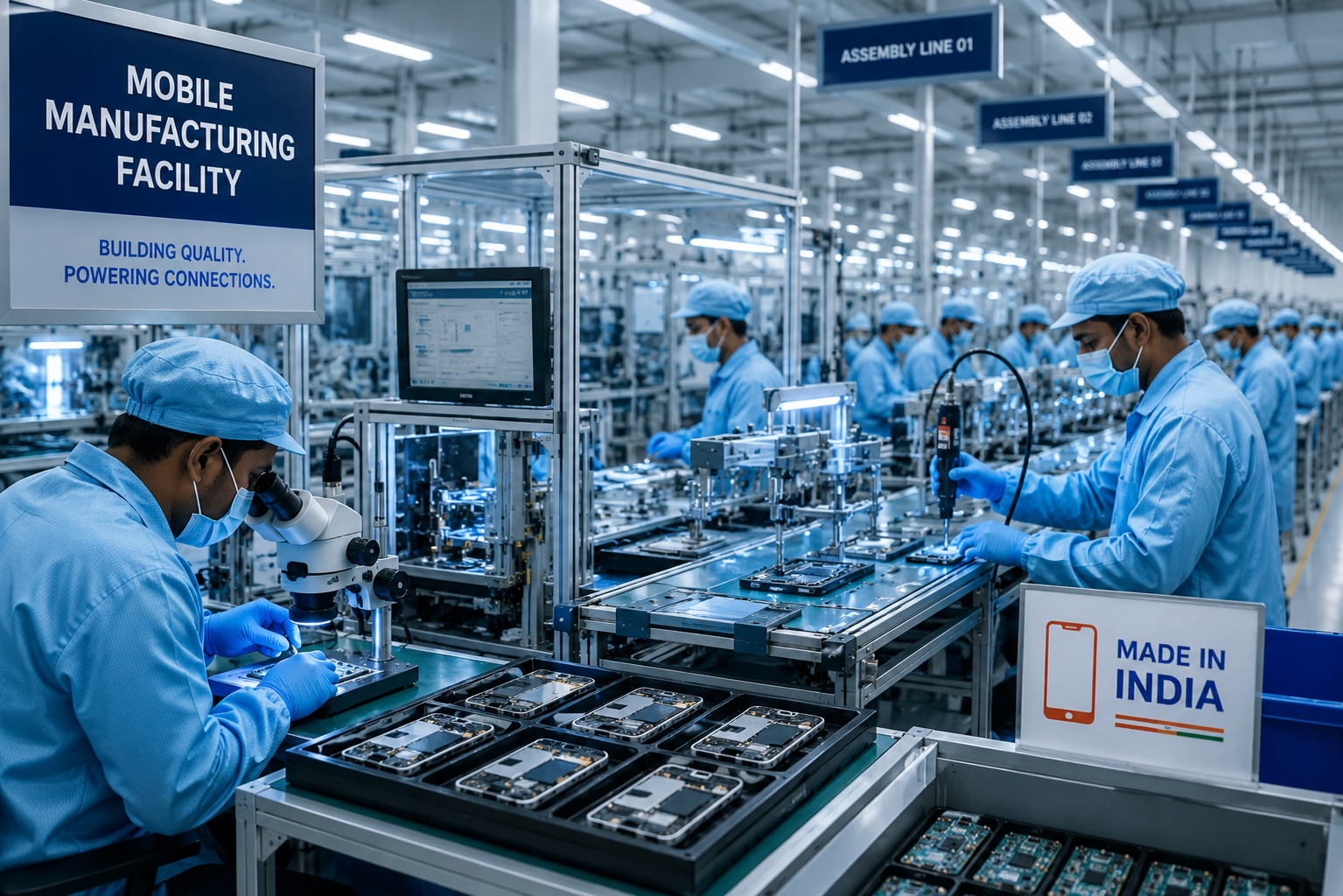
India’s mobile phone manufacturing story has been one of the most visible outcomes of the Production Linked Incentive framework. Over the last few years, the country has moved from being a largely import-dependent mobile phone market to becoming a major manufacturing and export base for smartphones. The earlier PLI scheme for large-scale electronics manufacturing helped attract large contract manufacturers, global smartphone brands and domestic electronics companies into India’s manufacturing ecosystem.
However, the next phase of electronics manufacturing policy is likely to be more demanding. The proposed PLI 2.0 for mobile phones, which is reportedly under finalisation, appears to be moving beyond assembly-led growth. The focus is expected to shift towards deeper domestic value addition, stronger backward integration, local sourcing of critical components, and alignment with India’s Electronics Component Manufacturing Scheme.
This is a significant policy shift. The earlier scheme helped India build scale in mobile phone assembly and exports. The proposed new scheme may seek to convert that scale into a more mature electronics manufacturing ecosystem.
Background: What the Earlier PLI Scheme Achieved
The PLI scheme for large-scale electronics manufacturing was notified in April 2020. It was designed to provide incentives on incremental sales of goods manufactured in India, particularly mobile phones and specified electronic components. The incentive range was 4% to 6% on incremental sales, subject to eligibility conditions and performance thresholds.
The scheme supported India’s ambition to become a major global mobile phone manufacturing hub. On headline performance, the results have been strong. Official data indicates that 32 beneficiary companies were approved under the scheme. Against the scheme target of ₹7,000 crore investment, actual investment had reached ₹17,519 crore till February 2026. Production under the scheme stood at about ₹11.01 lakh crore against the original target of ₹8.12 lakh crore, while exports crossed ₹6.20 lakh crore against a target of about ₹4.88 lakh crore.
These numbers indicate that the earlier PLI scheme succeeded in creating manufacturing scale. It also helped India strengthen its position in global mobile phone exports. Mobile phone production and exports have increased sharply over the last decade, and India has become one of the leading mobile phone manufacturing locations globally.
However, the scheme also exposed an important limitation. While India became strong in assembly and finished product exports, the level of local value addition remained materially lower than the next-stage policy objective.
Why a New PLI 2.0 Scheme Is Being Considered
The proposed PLI 2.0 for mobile phones is being discussed in the context of a maturing but still incomplete electronics manufacturing ecosystem. India has built scale in final assembly, but several high-value components continue to be imported.
Key smartphone components such as display assemblies, camera modules, chipsets, printed circuit boards, batteries, sensors, mechanical parts and other sub-assemblies account for a major share of the bill of materials. If these components are imported and only final assembly is carried out in India, the country captures limited value despite large production and export numbers.
This is the central issue that the new scheme appears to be addressing.
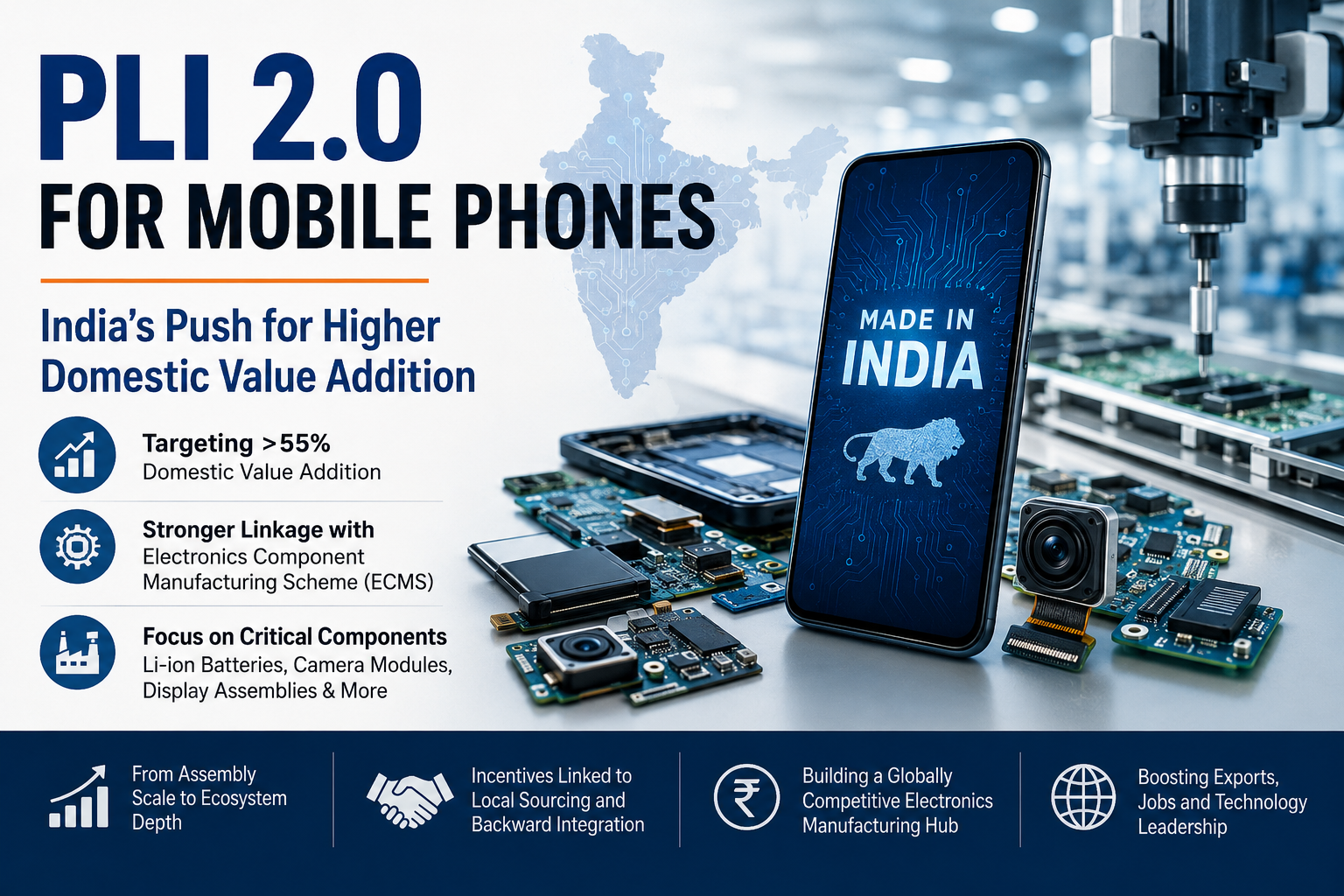
According to the newspaper reports, the proposed PLI 2.0 scheme may target domestic value addition of more than 55%. This would be a major increase from the earlier policy expectation of raising domestic value addition to around 35% to 40% for mobile phones. The reports also suggest that the Finance Ministry has favoured a more calibrated incentive structure, where payouts are linked more directly to local sourcing and backward integration.
This suggests that the new scheme may not merely reward production volume. It may reward the quality and depth of manufacturing undertaken in India.
Linkage with the Electronics Component Manufacturing Scheme
A key feature of the proposed revised approach is its likely alignment with the Electronics Component Manufacturing Scheme. ECMS was approved to strengthen India’s electronics component ecosystem by attracting investment in component manufacturing, improving domestic value addition and integrating Indian companies with global value chains.
This linkage is important because mobile phone assembly cannot become deeply domestic unless the component ecosystem develops alongside it. A mobile phone manufacturing scheme focused only on finished products may increase exports, but it cannot by itself create a strong supply base for critical components. Conversely, a component manufacturing scheme needs downstream demand from large assemblers and brands to make local component production commercially viable.
The proposed PLI 2.0 therefore appears to be an attempt to create a more integrated electronics manufacturing framework. Mobile phone manufacturers may be encouraged to procure more locally produced components, while component manufacturers may receive demand visibility from large smartphone assembly operations.
Likely Major Changes in PLI 2.0 Compared with the Earlier Scheme
The proposed PLI 2.0 scheme has not yet been officially notified. Therefore, the final design, incentive rates, eligibility criteria, investment thresholds, tenure and application process will need to be reviewed once the official scheme document is issued. However, based on available reporting and the policy direction visible from ECMS, the following differences are likely.
1. Higher Domestic Value Addition Target
The earlier scheme helped establish India as a large-scale mobile phone assembly and export base. The expected domestic value addition target was around 35% to 40% for mobile phones and 45% to 50% for electronic components.
The proposed PLI 2.0 may target domestic value addition of more than 55%. This is a materially higher ambition. It suggests that companies may need to demonstrate a stronger local sourcing base and deeper manufacturing presence in India to fully benefit from the scheme.
2. Shift from Volume Incentive to Localisation-Linked Incentive
The earlier scheme was largely structured around incremental sales of manufactured goods. While this was useful for attracting scale, it did not fully resolve dependence on imported components.
The revised scheme may link incentives more directly to backward integration, domestic sourcing and local manufacturing of critical components. This could mean that companies with higher local value addition may receive better incentive treatment than companies that mainly undertake assembly.
3. Stronger Role for Critical Components
The new scheme is likely to place greater emphasis on high-value components such as Li-ion batteries, camera modules, display assemblies and other critical sub-assemblies. These components materially influence the cost structure and domestic value addition of smartphones.
If companies manufacture or source these components locally, they may receive additional incentives or preferential treatment under the revised framework. This will encourage a move from assembly operations to a more complete electronics value chain.
4. Better Alignment between Mobile Manufacturing and Component Manufacturing
The earlier policy architecture included schemes for finished products and components, but the new approach may bring these together more deliberately. The proposed alignment with ECMS can help create an integrated structure where mobile phone manufacturers, component manufacturers and supply chain partners are linked through incentive design.
This could reduce fragmentation in policy implementation and improve the commercial case for local component production.
5. Greater Focus on Ecosystem Development
The earlier scheme created large-scale output. The new scheme may focus more on ecosystem depth. This includes supplier development, local procurement, component manufacturing, vendor qualification, production quality, logistics readiness, and export competitiveness.
For investors, this means that project planning will need to go beyond production capacity. It will also need to examine vendor ecosystems, sourcing strategy, component-level cost competitiveness, technology partnerships and phased localization plans.
|
Evaluating a PLI-linked electronics manufacturing opportunity? Hmsa Consultancy Services can help assess market viability, scheme fit, domestic value addition potential, sourcing strategy, project cost, financial returns, and execution readiness before investment commitment. Discuss your requirements with us here. |
Industry Implications of the Proposed Scheme
The proposed PLI 2.0 can have several implications for smartphone brands, EMS companies, component manufacturers and investors.
For large smartphone brands, the scheme may create pressure to deepen localisation and work with suppliers capable of manufacturing critical parts in India. For EMS companies, the competitive advantage may gradually shift from low-cost assembly to supply chain integration, component sourcing capability and ability to support localisation targets.
For component manufacturers, the proposed scheme can create a stronger demand environment. If large mobile phone assemblers are incentivised to source locally, component manufacturers may have better visibility of offtake and scale. This could support investments in camera modules, enclosures, PCBs, batteries, display-related assemblies and other sub-systems.
For mid-tier EMS players, the transition could create both opportunities and risks. As the earlier PLI scheme winds down, smartphone brands appear to be diversifying production across multiple manufacturers to reduce costs and improve bargaining power. Smaller and mid-tier manufacturers may gain volumes in the short term. However, over the medium term, they may also need to demonstrate stronger quality systems, working capital capacity, vendor management capability and compliance readiness.
Practical Considerations for Businesses Evaluating the Opportunity
Companies evaluating the proposed PLI 2.0 opportunity should avoid treating it only as an incentive application exercise. The commercial viability of a mobile phone or electronics component manufacturing project will depend on several linked factors.
- The project must be assessed from a demand and customer perspective. Manufacturing capacity should be linked to confirmed or realistically addressable demand from brands, EMS companies or export customers.
- The localization plan must be credible. If the scheme places greater weight on domestic value addition, companies will need to demonstrate how they intend to source components locally, what manufacturing steps will be undertaken in India, and how localization will increase over time.
- Technology and supplier partnerships will become important. Many high-value components require technical capability, process control, quality systems and customer approvals. These cannot be built only through capital expenditure.
- Financial modelling must account for incentive uncertainty. Since the final PLI 2.0 notification is awaited, businesses should prepare base, upside and downside cases. The project should be tested both with and without incentive benefits.
- Working capital and execution readiness will be critical. Electronics manufacturing has demanding inventory cycles, customer qualification requirements, import dependencies, price volatility and strict delivery standards. A project may look attractive on paper but fail if supply chain and execution capabilities are weak.
How Hmsa Consultancy Services Can Support
Planning to evaluate a mobile phone manufacturing, electronics component manufacturing, or PLI-linked investment opportunity? Before moving into investment commitment, scheme application, technology tie-up, vendor discussions or land and capacity planning, it is important to assess commercial viability, policy fit, domestic value addition potential, customer demand, sourcing strategy and financial returns.
Hmsa Consultancy Services supports clients through structured feasibility studies, detailed project reports, business plans, market assessments, incentive eligibility evaluation, financial modelling oversight, and strategic advisory for manufacturing and policy-linked investment opportunities. In the context of the proposed PLI 2.0 and ECMS-linked electronics manufacturing ecosystem, Hmsa can assist businesses in evaluating whether the opportunity is commercially viable, operationally executable and aligned with the likely direction of government incentives.
What Businesses Should Watch Next
The most important development to track will be the official notification or guideline document for the proposed PLI 2.0 scheme. Businesses should specifically review the final scheme outlay, eligible products, incentive rates, domestic value addition requirements, investment thresholds, tenure, application timeline, approval process and compliance requirements.
They should also track how the scheme defines local value addition. The definition of eligible domestic sourcing, treatment of imported components, documentation requirements and audit methodology will materially affect project feasibility.
The second area to watch is the implementation of ECMS. The success of PLI 2.0 will depend partly on how quickly India’s component manufacturing base develops. If ECMS-supported component facilities become operational on time, mobile phone manufacturers may have a stronger base for local procurement. If component capacity is delayed, achieving aggressive domestic value addition targets may become difficult.
The third area to watch is industry behaviour after the earlier PLI period. As incentives reduce or expire under the earlier scheme, smartphone brands may become more cost-sensitive in selecting EMS partners. This could intensify competition but also create opportunities for manufacturers that combine cost efficiency with localisation capability.
Conclusion
The proposed PLI 2.0 for mobile phones represents a possible shift in India’s electronics manufacturing strategy. The earlier PLI scheme helped India build scale in mobile phone assembly and exports. The next phase is likely to focus on deeper domestic value addition, stronger component manufacturing and a more integrated electronics supply chain.
This is a natural progression. Assembly-led growth was an important first step, but long-term competitiveness will depend on how much value India can capture within the country. If the proposed scheme is designed and implemented effectively, it can support a more mature electronics manufacturing ecosystem.
However, the opportunity must be evaluated carefully. Higher localisation targets can improve long-term industrial depth, but they also increase execution complexity. Companies will need to assess market demand, technology access, supplier readiness, capital requirements, customer commitments, incentive eligibility and financial viability before committing investment.
Reference: The Economic Times