
The Supreme Court’s ruling upholding 28% GST on online gaming transactions marks a major turning point for India’s real-money gaming industry. The judgment has significant implications not only for online gaming platforms, but also for investors, lenders, acquirers, tax advisors and businesses operating in regulated digital sectors.
The core issue before the Court was whether online gaming transactions involving monetary stakes should be treated differently from betting and gambling for GST purposes, particularly where platforms argued that many games were skill-based and that GST should apply only on platform commission or gross gaming revenue. The Court’s ruling supports the government’s position that where money is staked and outcomes are uncertain, the transaction can fall within the ambit of betting and gambling-linked actionable claims under the GST framework.
For the industry, this is not merely a tax rate issue. It affects historical liabilities, balance sheet strength, business model viability, investor confidence, compliance architecture and future growth strategy.
Why the GST Dispute Became So Important
Before the government’s position was formalised more clearly, several online gaming companies treated GST as applicable on platform commission or gross gaming revenue rather than on the full contest entry amount or bet value. In simple terms, if a player deposited or staked ₹100 and the platform retained ₹10 as its fee, many businesses took the position that GST should apply only on the platform’s ₹10 revenue.
The government took a different view. It argued that the taxable value should be the full face value of the amount staked or deposited for participation, not merely the platform margin. This distinction has a very large financial impact. GST at 28% on platform commission is materially different from GST at 28% on the entire money-stake value.
The GST Council had earlier recommended a uniform 28% GST treatment for online gaming, casinos and horse racing on the full face value. Subsequent amendments and notifications brought online money gaming, casinos and similar actionable claims more clearly within the GST valuation framework.
The industry challenged these demands, particularly on the grounds that skill-based games should not be equated with betting or gambling, and that retrospective application would impose an unreasonable burden on companies that had structured their tax positions differently.
What the Supreme Court Has Held
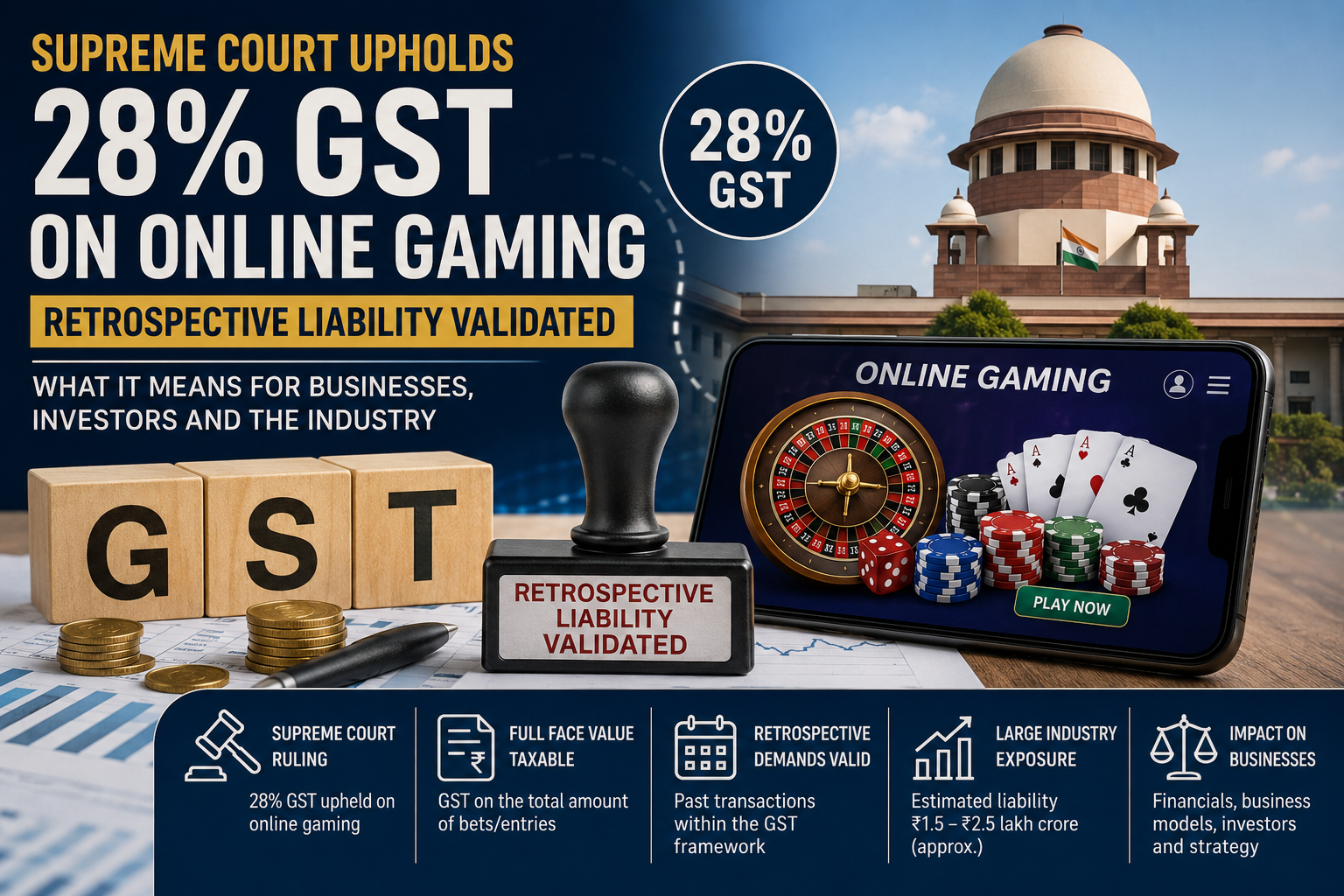
The Supreme Court has upheld the constitutional validity of the 28% GST levy on online gaming involving monetary stakes. The ruling supports the position that online gaming platforms are not merely intermediaries facilitating transactions between players. Instead, where the platform enables participation in money-stake games, the supply can be treated as a taxable actionable claim under the GST framework.
The Court also appears to have accepted that the game-of-skill versus game-of-chance distinction does not prevent GST applicability where monetary stakes and uncertain outcomes are involved. This is important because many online gaming companies historically relied on the distinction between skill-based formats such as fantasy sports, poker or rummy and pure games of chance.
The ruling also validates the levy on the full face value of bets or contest entry amounts. This means GST is not limited to the platform fee, commission or net revenue earned by the operator. The tax base becomes the full amount committed by players for participation.
Most significantly, the ruling supports retrospective tax demands. This is the most serious financial concern for the industry because it brings past transactions into the tax net under the government’s interpretation.
Scale of Potential Exposure
Media reports suggest that the retrospective GST exposure for online gaming companies could run into very large amounts. The news report shared estimates retrospective GST payments in the range of approximately ₹1.5 lakh crore to ₹2.3 lakh crore, while other reports have placed potential exposure at around ₹2.5 lakh crore, including penalty-related elements.
The final liability for each company will depend on the specific show-cause notices issued, adjudication outcomes, interest, penalties, available legal remedies, tax already paid, and the precise period covered by departmental demands.
However, even if the final payable amount is lower than headline estimates, the ruling creates a severe financial and operational challenge for the sector. For many companies, the liability may be disproportionate to their net worth, cash reserves or cumulative profits.
Why the Ruling Matters Beyond Online Gaming
The ruling may also influence the tax treatment of other activities involving monetary stakes, such as casinos, horse racing, betting-linked formats and similar actionable claim structures. The broader implication is that the GST framework can be applied uniformly to transactions where money is placed at risk for uncertain outcomes.
This strengthens the government’s position in sectors where digital platforms argue that they are technology intermediaries rather than principal suppliers of taxable services or goods. The ruling therefore has relevance beyond gaming. It reinforces a broader regulatory principle: business models built around digital transactions, money flows and platform facilitation must be assessed not only from a commercial lens, but also from tax, regulatory and legal interpretation perspectives.
Likely Impact on Online Gaming Companies
The immediate impact is likely to be financial stress. Companies facing large retrospective demands may need to review their balance sheets, assess contingent liabilities, initiate restructuring discussions and consider capital infusion or settlement strategies.
The ruling may also force a rethink of unit economics. If GST is levied on full face value, real-money gaming platforms may find it difficult to maintain earlier pricing, promotional incentives and payout structures. A platform that was commercially viable when tax applied only to commission may become structurally weaker when tax applies to the full stake value.
Smaller operators may face survival challenges because they may not have the capital reserves, investor backing or alternative product lines needed to absorb such liabilities. Larger platforms may have more options, including pivoting towards free-to-play models, advertising-led engagement, subscription products, non-money gaming or broader sports entertainment offerings.
The ruling may also accelerate consolidation. Companies with weaker compliance histories or large unresolved tax demands may become difficult to fund or acquire. Stronger players may survive, but only after reworking business models and resolving tax uncertainty.
Implications for Investors and Lenders
For investors, the ruling highlights the importance of tax and regulatory due diligence in digital business models. Historical revenue growth alone is not sufficient to assess business quality. Investors will need to examine the legal basis of revenue recognition, GST treatment, tax provisioning, pending notices, litigation exposure and management’s approach to compliance.
For lenders, the concern is even more direct. Retrospective statutory liabilities can rank ahead of other financial obligations and may materially impair debt service ability. Any lender evaluating exposure to gaming, digital commerce, fintech, fantasy sports, transaction platforms or other regulated digital models will need to assess contingent liabilities in greater detail.
For strategic acquirers, this ruling increases the importance of transaction structuring. Indemnities, escrow arrangements, purchase price adjustments and liability ring-fencing may become essential where historical tax exposure is uncertain.
Business Model Lessons from the Ruling
The online gaming GST ruling offers a broader lesson for emerging businesses. Regulatory risk should not be treated as a secondary compliance matter after the business scales. It should be assessed at the business model design stage.
A company may have strong customer demand, attractive revenue growth and investor interest, but if the underlying tax or regulatory interpretation is uncertain, the business may carry hidden fragility. This is particularly relevant for sectors involving digital platforms, user deposits, wallet flows, incentive structures, contest participation, regulated products or government-supervised activities.
Businesses must therefore evaluate not only whether the opportunity is commercially attractive, but also whether the revenue model is legally sustainable, tax compliant, operationally defensible and financially resilient under adverse regulatory interpretation.
| Businesses operating in online gaming, digital platforms, fintech-linked engagement models, consumer transaction platforms or other regulated sectors cannot assess growth plans only through market size and revenue potential. Tax exposure, regulatory interpretation, business model resilience, cash flow impact and investor confidence must be evaluated before expansion, fund raising, acquisition, restructuring or strategic repositioning. Hmsa Consultancy Services supports businesses and investors in evaluating such issues through feasibility studies, business planning, commercial due diligence, financial assessment, business model review and restructuring advisory. If your organisation is assessing a regulated digital business, reviewing exposure to policy or tax changes, or evaluating investment and expansion decisions, share your requirements with us here. |
Strategic Questions for Gaming and Digital Platform Businesses
Following the ruling, affected companies and adjacent digital businesses should reassess several key questions.
First, how much historical tax exposure exists under the latest interpretation? Second, has the company created adequate provisions or disclosed contingent liabilities appropriately? Third, does the current business model remain commercially viable if GST is applied on full transaction value? Fourth, are user pricing, payouts, incentives and platform fees aligned with the post-ruling tax environment? Fifth, can the business shift towards alternative formats such as free-to-play, subscription, advertising-led or enterprise partnerships?
These questions are not limited to tax departments. They affect strategy, finance, investor relations, operations, product design and business continuity planning.
How Hmsa Consultancy Services Can Support
Hmsa Consultancy Services helps businesses and investors assess the commercial and financial impact of regulatory and tax developments such as the online gaming GST ruling.
Hmsa can support business model evaluation, financial feasibility analysis, commercial due diligence, restructuring assessment and cash flow planning. For companies facing regulatory or tax-related challenges, Hmsa helps identify risks, evaluate strategic options and assess the overall impact on business performance and investment decisions.
Conclusion
The Supreme Court’s ruling on 28% GST for online gaming is a structural development for India’s real-money gaming sector. It confirms the government’s position on full face value taxation, reduces the strength of the skill-versus-chance distinction for GST purposes where monetary stakes are involved, and validates retrospective demands.
For the industry, the implications are serious. Large tax liabilities may force financial restructuring, business model changes, investor reassessment and consolidation. For other digital businesses, the ruling is an important reminder that regulatory interpretation can materially affect enterprise value.
The larger business lesson is clear: in regulated and transaction-led sectors, commercial growth must be supported by robust tax assessment, regulatory clarity, financial resilience and credible contingency planning.
Reference: The Economic Times